> ## Documentation Index
> Fetch the complete documentation index at: https://docs.kelviq.com/llms.txt
> Use this file to discover all available pages before exploring further.

# Changelog

> Every Kelviq release across the dashboard, API, SDKs, and developer tools

export const ChangelogFilter = ({products}) => {
  const slugify = name => name.toLowerCase().replace(/[^a-z0-9]+/g, "-").replace(/^-|-$/g, "");
  const options = products.map(name => ({
    name,
    slug: slugify(name)
  }));
  const [selected, setSelected] = useState(null);
  useEffect(() => {
    const syncFromHash = () => {
      const hash = decodeURIComponent(window.location.hash.slice(1));
      if (hash === "") setSelected(null); else if (options.some(option => option.slug === hash)) setSelected(hash);
    };
    syncFromHash();
    window.addEventListener("hashchange", syncFromHash);
    return () => window.removeEventListener("hashchange", syncFromHash);
  }, []);
  useEffect(() => {
    const sync = () => {
      document.querySelectorAll(".update-container:not([data-changelog-product])").forEach(entry => {
        const tag = entry.querySelector('[data-component-part="update-tag"]');
        if (tag) entry.setAttribute("data-changelog-product", slugify(tag.textContent));
      });
      document.querySelectorAll('a[target="_blank"][href*="/changelog#"]').forEach(link => {
        const {pathname, hash} = new URL(link.href);
        if (pathname !== window.location.pathname) return;
        link.setAttribute("href", `${pathname}${hash}`);
        link.removeAttribute("target");
        link.removeAttribute("rel");
      });
    };
    sync();
    const observer = new MutationObserver(sync);
    observer.observe(document.body, {
      childList: true,
      subtree: true
    });
    return () => observer.disconnect();
  }, []);
  useEffect(() => {
    document.body.setAttribute("data-changelog-page", "");
    return () => document.body.removeAttribute("data-changelog-page");
  }, []);
  useEffect(() => {
    const sidebarLinks = () => [...document.querySelectorAll("a.nav-anchor")].filter(link => link.getAttribute("href")?.startsWith(window.location.pathname));
    const markActive = () => {
      sidebarLinks().forEach(link => {
        const hash = link.getAttribute("href").split("#")[1] ?? null;
        link.setAttribute("data-changelog-active", String(hash === selected));
      });
    };
    markActive();
    const observer = new MutationObserver(markActive);
    observer.observe(document.body, {
      childList: true,
      subtree: true
    });
    return () => observer.disconnect();
  }, [selected]);
  const select = slug => {
    setSelected(slug);
    const {pathname, search} = window.location;
    window.history.replaceState(null, "", slug ? `${pathname}${search}#${slug}` : `${pathname}${search}`);
  };
  return <div className="changelog-filter not-prose">
      <style>{`
        /* The bar sticks just under the navbar, which ends 2.5rem above --scroll-mt. */
        .changelog-filter {
          position: sticky; top: calc(var(--scroll-mt, 152px) - 2.5rem); z-index: 20;
          margin-top: 1.5rem; padding-block: 0.75rem;
          background: rgb(var(--background-light, 255 255 255));
          border-bottom: 1px solid rgb(0 0 0 / 0.06);
        }
        .dark .changelog-filter {
          background: rgb(var(--background-dark, 14 12 13));
          border-bottom-color: rgb(255 255 255 / 0.06);
        }
        .changelog-filter-list {
          display: flex; gap: 0.375rem; overflow-x: auto; scrollbar-width: none;
        }
        .changelog-filter-list::-webkit-scrollbar { display: none; }
        .changelog-filter button {
          flex-shrink: 0; padding: 0.3125rem 0.75rem; border-radius: 9999px;
          font-size: 0.8125rem; font-weight: 500; line-height: 1.25rem; white-space: nowrap;
          border: 1px solid transparent; background: rgb(0 0 0 / 0.04); color: rgb(75 85 99);
          cursor: pointer; transition: background-color 120ms, color 120ms, border-color 120ms;
        }
        .changelog-filter button:hover { background: rgb(0 0 0 / 0.08); color: rgb(17 24 39); }
        .changelog-filter button[aria-pressed="true"] {
          background: rgb(var(--primary, 255 87 34) / 0.1); color: rgb(var(--primary-dark, 220 65 0));
          border-color: rgb(var(--primary, 255 87 34) / 0.35);
        }
        .dark .changelog-filter button { background: rgb(255 255 255 / 0.05); color: rgb(156 163 175); }
        .dark .changelog-filter button:hover { background: rgb(255 255 255 / 0.1); color: rgb(243 244 246); }
        .dark .changelog-filter button[aria-pressed="true"] {
          background: rgb(var(--primary-light, 255 140 102) / 0.12); color: rgb(var(--primary-light, 255 140 102));
          border-color: rgb(var(--primary-light, 255 140 102) / 0.35);
        }
        /* Keep version labels and anchor jumps below the bar instead of under it. */
        .update-container > div:first-child { top: calc(var(--scroll-mt, 152px) + 1.75rem) !important; }
        .update-container { scroll-margin-top: calc(var(--scroll-mt, 152px) + 1.75rem); }
        ${selected ? `.update-container:not([data-changelog-product="${selected}"]) { display: none; }` : ""}
      `}</style>
      <div className="changelog-filter-list" role="group" aria-label="Filter by product">
        <button type="button" aria-pressed={selected === null} onClick={() => select(null)}>
          All
        </button>
        {options.map(({name, slug}) => <button key={slug} type="button" aria-pressed={selected === slug} onClick={() => select(slug)}>
            {name}
          </button>)}
      </div>
    </div>;
};

<ChangelogFilter products={["App","JS SDK","React SDK","Node SDK","Python SDK","JS Promotions UI","MCP Server","CLI","API"]} />

<Update label="v1.1.0" description="September 16, 2026" tags={["MCP Server"]}>
  ### New Features

  #### Discount and webhook tools

  11 new tools bring the server to 56:

  * Discounts: `discount_list`, `discount_create`, `discount_retrieve`, `discount_update` to enable or disable a code, and `discount_archive`
  * Webhooks: `webhook_endpoint_list`, `webhook_endpoint_create`, `webhook_endpoint_retrieve`, `webhook_endpoint_update`, `webhook_endpoint_delete`, and `webhook_log_list` for delivery attempts from the last 30 days

  Webhook signing secrets are hidden in tool results so they don't end up in your AI conversation. Pass `revealSecret: true` when you need the value.

  ### Improvements

  * `checkout_create_session` accepts `trialPeriod`, `billingPeriodsEnabled` and `email`.
  * `subscription_update` accepts `prorationBehavior`, and `subscription_cancel` accepts `cancellationFeedback` and `cancellationComment`.
</Update>

<Update label="v0.3.0" description="September 15, 2026" tags={["CLI"]}>
  ### Breaking Changes

  #### `KELVIQ_SERVER_API_KEY` follows `KELVIQ_ENV`

  `KELVIQ_SERVER_API_KEY` now belongs to the environment named by `KELVIQ_ENV`, and `KELVIQ_ENV` defaults to `sandbox` — the same rules as the [MCP server](/guides/mcp-server). It previously always meant your production key.

  If you keep a production key in `KELVIQ_SERVER_API_KEY`, add `KELVIQ_ENV=production` or rename the variable to `KELVIQ_PRODUCTION_SERVER_API_KEY`. Keys saved with `kelviq login` are unaffected, and commands still target production only when you pass `--prod`.

  ### New Features

  #### Environment-named keys

  `KELVIQ_SANDBOX_SERVER_API_KEY` and `KELVIQ_PRODUCTION_SERVER_API_KEY` always apply to their own environment and take priority over `KELVIQ_SERVER_API_KEY`, so one shell or CI job can hold both keys for `kelviq promote`.

  ### Improvements

  * `kelviq env` shows which environment `KELVIQ_ENV` points your unprefixed variables at.
  * When a key is missing, the error names every way to provide it, and tells you if `KELVIQ_SERVER_API_KEY` is set for the other environment.
  * An invalid `KELVIQ_ENV` value stops the command instead of guessing.

  ### Fixes

  * `kelviq push` now works with a globally installed CLI in projects that don't install `@kelviq/cli` locally. Previously it failed with `Cannot find package '@kelviq/cli'`.
</Update>

<Update label="v1.7.9" description="September 15, 2026" tags={["API"]}>
  ### New Features

  #### Discounts API

  Discount codes can now be managed directly through the API, authenticated with your server API key:

  * `GET /discount/` — list discounts
  * `POST /discount/` — create a discount (Merchant of Record organizations only)
  * `GET /discount/{id}/` — retrieve a discount
  * `PATCH /discount/{id}/` — enable or disable a discount
  * `DELETE /discount/{id}/` — archive a discount

  ```json theme={null}
  {
    "discountType": "PERCENTAGE",
    "percentageOff": 20,
    "name": "Summer Sale",
    "code": "SUMMER20",
    "duration": "ONCE"
  }
  ```

  See the [Discounts API reference](/api-reference/introduction) for the full request/response shape, including restricting a discount to specific products or plans with `appliesTo`.

  #### Manage webhook endpoints via API

  `WebhookEndpoint` resources — previously dashboard-only — are now fully manageable through the API:

  * `GET /webhook/endpoints/` — list webhook endpoints
  * `POST /webhook/endpoints/` — create a webhook endpoint
  * `GET /webhook/endpoints/{id}/` — retrieve a webhook endpoint
  * `PATCH /webhook/endpoints/{id}/` — update the URL, subscribed events, or enabled state
  * `DELETE /webhook/endpoints/{id}/` — delete a webhook endpoint

  ```json theme={null}
  {
    "url": "https://example.com/webhooks/kelviq",
    "events": ["invoice.paid", "subscription.cancelled"],
    "enabled": true
  }
  ```

  The signing secret used to verify the `webhook-signature` header is generated automatically and returned in the create response.
</Update>

<Update label="v1.0.0" description="September 14, 2026" tags={["MCP Server"]}>
  ### Breaking Changes

  #### Sandbox is now the default environment

  When `KELVIQ_ENV` isn't set, the server now uses your **sandbox** environment instead of production, so an AI client can't change live data unless you choose production explicitly.

  If you use the MCP server with a production key, add `KELVIQ_ENV=production` to its environment. Without it, requests go to the sandbox host and return 403 errors — nothing is written.

  ### Improvements

  * The startup log shows which environment the server is using, and warns when `KELVIQ_ENV` isn't set.
  * The server tells the connected AI client which environment its tools act on.
  * 401 and 403 errors now include a hint: when `KELVIQ_ENV` isn't set, they explain the sandbox default and how to use a production key; otherwise they name the active environment and link its API keys page.
  * Setup examples now run `npx -y @kelviq/mcp-server@latest`, so clients pick up new releases instead of a cached copy.

  ### Fixes

  * If your MCP client passes an unexpanded placeholder such as `${KELVIQ_ENV}` instead of a value, the server now treats that variable as unset and warns at startup. Previously the server failed to start, or sent the placeholder text as your API key.
</Update>

<Update label="v1.7.8" description="September 10, 2026" tags={["API"]}>
  ### New Features

  #### Limit checkout to selected billing periods

  `POST /checkout/` now accepts `billingPeriodsEnabled`, a comma-separated list of billing periods to display and allow during checkout. Values are case-insensitive and normalized to uppercase. A checkout attempt using a billing period outside this list is rejected.

  ```json theme={null}
  {
    "planIdentifier": "premium-plan",
    "chargePeriod": "MONTHLY",
    "billingPeriodsEnabled": "MONTHLY,YEARLY",
    "successUrl": "https://example.com/checkout/success"
  }
  ```

  `GET /monetization/product-offering/{product_id}/` also accepts `billing_periods_enabled` to return only the requested billing periods. Static checkout links support the same snake-case parameter.

  #### Prefill the checkout email address

  `POST /checkout/` now accepts `email` to prefill the checkout page. Combine it with `lockEmail: true` when the customer must not edit the address.

  ```json theme={null}
  {
    "planIdentifier": "premium-plan",
    "chargePeriod": "MONTHLY",
    "email": "customer@example.com",
    "lockEmail": true,
    "successUrl": "https://example.com/checkout/success"
  }
  ```

  Static checkout links can prefill the same value with the `email` query parameter.
</Update>

<Update label="v2.8.0" description="September 9, 2026" tags={["Node SDK"]}>
  ### New Features

  #### Refunds

  A new `client.refunds` module lets you list, create, and retrieve refunds.

  ```typescript theme={null}
  const refund = await client.refunds.create({
    orderId: "ORD-20260715123000-A1B2C",
    amountUnits: 2500,
    reason: "REQUESTED_BY_CUSTOMER",
    internalNote: "Customer requested a partial refund.",
  });

  const page = await client.refunds.list({ status: "SUCCEEDED", page: 1, pageSize: 10 });

  const retrieved = await client.refunds.retrieve({ refundId: refund.id });
  ```

  `client.refunds.create()` accepts either `amountUnits` (minor currency unit) or `amount` (major currency unit) for a partial refund; omit both to refund the order's entire remaining refundable balance. `client.refunds.list()` supports `search`, `status`, `startDate`, `endDate`, `page`, and `pageSize` filters.

  #### Payment Methods

  A new `client.paymentMethods` module lists saved payment methods, optionally filtered by `customerId` or `customerEmail`.

  ```typescript theme={null}
  const methods = await client.paymentMethods.list({ customerId: "cust_789" });
  console.log(methods.results[0].methodData.brand, methods.results[0].methodData.last4);
  ```

  Only payment methods with status `succeeded` are returned.

  #### Transactions

  A new `client.transactions` module lists financial transactions, including the itemized Merchant of Record fee breakdown when applicable.

  ```typescript theme={null}
  const transactions = await client.transactions.list({ status: "success", startDate: "2026-07-01" });
  console.log(transactions.results[0].amountTotal, transactions.results[0].morFeeBreakdown);
  ```

  `client.transactions.list()` supports `search`, `status`, `startDate`, `endDate`, `page`, and `pageSize` filters.
</Update>

<Update label="v2.8.0" description="September 9, 2026" tags={["Python SDK"]}>
  ### New Features

  #### Refunds

  The synchronous and asynchronous clients now provide a `refunds` module for listing, creating, and retrieving refunds.

  ```python theme={null}
  refund = client.refunds.create(
      orderId="ORD-20260715123000-A1B2C",
      amountUnits=2500,
      reason="REQUESTED_BY_CUSTOMER",
      internalNote="Customer requested a partial refund.",
  )

  page = client.refunds.list(status="SUCCEEDED", page=1, page_size=10)

  retrieved = client.refunds.retrieve(refund.id)
  ```

  **Async variant:**

  ```python theme={null}
  refund = await async_client.refunds.create(
      orderId="ORD-20260715123000-A1B2C",
      amountUnits=2500,
  )
  ```

  `client.refunds.create()` accepts either `amountUnits` (minor currency unit) or `amount` (major currency unit) for a partial refund; omit both to refund the order's entire remaining refundable balance. `client.refunds.list()` supports `search`, `status`, `start_date`, `end_date`, `page`, and `page_size` filters. Pydantic models validate parameters and provide typed refund records.

  #### Payment Methods

  The synchronous and asynchronous clients now provide a `payment_methods` module that lists saved payment methods, optionally filtered by `customer_id` or `customer_email`.

  ```python theme={null}
  methods = client.payment_methods.list(customer_id="cust_789")
  print(methods.results[0].methodData["brand"], methods.results[0].methodData["last4"])
  ```

  Only payment methods with status `succeeded` are returned.

  #### Transactions

  The synchronous and asynchronous clients now provide a `transactions` module that lists financial transactions, including the itemized Merchant of Record fee breakdown when applicable.

  ```python theme={null}
  transactions = client.transactions.list(status="success", start_date="2026-07-01")
  print(transactions.results[0].amountTotal, transactions.results[0].morFeeBreakdown)
  ```

  `client.transactions.list()` supports `search`, `status`, `start_date`, `end_date`, `page`, and `page_size` filters.
</Update>

<Update label="v2.7.4" description="September 8, 2026" tags={["Node SDK"]}>
  ### New Features

  #### Control How Subscription Updates Are Billed

  `client.subscriptions.update()` now supports `prorationBehavior`, using the exported `PRORATION_BEHAVIORS` constant. It controls when the customer is billed for a mid-period change: `IMMEDIATE_CHARGE` invoices the difference right now, `PRORATE_NEXT_INVOICE` bills it on the next invoice, and `NO_PRORATION` changes the plan without crediting or charging for the partial period.

  ```typescript theme={null}
  import { CHARGE_PERIOD_CHOICES, PRORATION_BEHAVIORS } from "@kelviq/node-sdk";

  const subscription = await client.subscriptions.update({
    subscriptionId: "78058918-9746-4280-9b9b-1bd5115eec6e",
    planIdentifier: "premium-plan",
    chargePeriod: CHARGE_PERIOD_CHOICES.MONTHLY,
    prorationBehavior: PRORATION_BEHAVIORS.PRORATE_NEXT_INVOICE,
  });
  ```

  The SDK serializes the option as `proration_behavior`. Omit it to use your organization's default.

  <Warning>
    Changing `chargePeriod` to a different billing interval resets the billing cycle and invoices the new period immediately, whichever value you pass — with `NO_PRORATION`, without any credit for unused time on the old plan.
  </Warning>

  #### Preview Subscription Updates

  `client.subscriptions.previewUpdate()` calculates the financial effect of a proposed subscription update without changing the subscription, creating an invoice, or charging the customer. It accepts the same plan, charge period, proration behavior, features, IP address, and trial-end options used by an update.

  ```typescript theme={null}
  const preview = await client.subscriptions.previewUpdate({
    subscriptionId: "78058918-9746-4280-9b9b-1bd5115eec6e",
    planIdentifier: "premium-plan",
    chargePeriod: CHARGE_PERIOD_CHOICES.YEARLY,
    prorationBehavior: PRORATION_BEHAVIORS.PRORATE_NEXT_INVOICE,
    features: [{ identifier: "seats", quantity: 10 }],
  });

  console.log(preview.recurringAmount, preview.amountChargedImmediately);
  ```

  The response includes typed major- and minor-unit amounts, the next payment attempt, and preview invoice line items.

  #### Set a Custom Trial Period at Checkout

  `client.checkout.createSession()` now accepts `trialPeriod`. Pass an integer greater than or equal to `1` to override the selected plan's configured trial period. Invalid values are rejected by the SDK before a request is sent.

  ```typescript theme={null}
  const session = await client.checkout.createSession({
    planIdentifier: "premium-plan",
    chargePeriod: CHARGE_PERIOD_CHOICES.MONTHLY,
    successUrl: "https://example.com/checkout/success",
    trialPeriod: 14,
  });
  ```

  #### Use a Custom Amount for One-Time Charges

  `client.charges.create()` now accepts `customAmount` and `taxBehavior`. `customAmount` must be greater than zero and requires `currencyCode`; `taxBehavior` accepts `INCLUSIVE` or `EXCLUSIVE`.

  ```typescript theme={null}
  const charge = await client.charges.create({
    planIdentifier: "lifetime-access",
    chargePeriod: "ONE_TIME",
    customerId: "cust_789",
    currencyCode: "USD",
    customAmount: 49.99,
    taxBehavior: "INCLUSIVE",
  });
  ```

  ### Deprecations

  `probationBehaviour` and `PROBATION_BEHAVIOURS` are deprecated in favour of `prorationBehavior` and `PRORATION_BEHAVIORS` (`probation` was a typo for `proration`). The old field still works.

  `PROBATION_BEHAVIOURS.NEXT_BILLING_CYCLE` and `PROBATION_BEHAVIOURS.PRO_RATA` were never supported by the API and are rejected by it. Use `PRORATION_BEHAVIORS.NO_PRORATION` and `PRORATION_BEHAVIORS.PRORATE_NEXT_INVOICE` instead. `IMMEDIATE_CHARGE` is unchanged and now works.
</Update>

<Update label="v2.7.4" description="September 8, 2026" tags={["Python SDK"]}>
  ### New Features

  #### Control How Subscription Updates Are Billed

  The synchronous and asynchronous `client.subscriptions.update()` methods now support `prorationBehavior`, with a `ProrationBehavior` enum exported from the package. It controls when the customer is billed for a mid-period change: `IMMEDIATE_CHARGE` invoices the difference right now, `PRORATE_NEXT_INVOICE` bills it on the next invoice, and `NO_PRORATION` changes the plan without crediting or charging for the partial period.

  ```python theme={null}
  from kelviq_sdk import ProrationBehavior

  subscription = client.subscriptions.update(
      subscriptionId="78058918-9746-4280-9b9b-1bd5115eec6e",
      planIdentifier="premium-plan",
      chargePeriod="MONTHLY",
      prorationBehavior=ProrationBehavior.PRORATE_NEXT_INVOICE,
  )
  ```

  The SDK validates the value and serializes it as `proration_behavior`. Omit it to use your organization's default.

  <Warning>
    Changing `chargePeriod` to a different billing interval resets the billing cycle and invoices the new period immediately, whichever value you pass — with `NO_PRORATION`, without any credit for unused time on the old plan.
  </Warning>

  #### Preview Subscription Updates

  The synchronous and asynchronous subscription clients now provide `preview_update()`. It calculates the financial effect of a proposed update without changing the subscription, creating an invoice, or charging the customer.

  ```python theme={null}
  preview = client.subscriptions.preview_update(
      subscriptionId="78058918-9746-4280-9b9b-1bd5115eec6e",
      planIdentifier="premium-plan",
      chargePeriod="YEARLY",
      prorationBehavior=ProrationBehavior.PRORATE_NEXT_INVOICE,
      features=[{"identifier": "seats", "quantity": 10}],
  )

  print(preview.recurringAmount, preview.amountChargedImmediately)
  ```

  The returned Pydantic models include major- and minor-unit amounts, the next payment attempt, and preview invoice line items.

  #### Set a Custom Trial Period at Checkout

  The synchronous and asynchronous `checkout.create_session()` methods now accept `trialPeriod`. Pass an integer greater than or equal to `1` to override the selected plan's configured trial period.

  ```python theme={null}
  session = client.checkout.create_session(
      planIdentifier="premium-plan",
      chargePeriod="MONTHLY",
      successUrl="https://example.com/checkout/success",
      trialPeriod=14,
  )
  ```

  #### Use a Custom Amount for One-Time Charges

  The synchronous and asynchronous `charges.create()` methods now accept `customAmount` and `taxBehavior`. `customAmount` must be greater than zero and requires `currencyCode`; `taxBehavior` accepts `INCLUSIVE` or `EXCLUSIVE`.

  ```python theme={null}
  charge = client.charges.create(
      planIdentifier="lifetime-access",
      chargePeriod="ONE_TIME",
      customerId="cust_789",
      currencyCode="USD",
      customAmount=49.99,
      taxBehavior="INCLUSIVE",
  )
  ```

  ### Changes

  `successUrl` is now required when calling the synchronous or asynchronous `checkout.create_session()` method, matching the API contract.

  ### Deprecations

  `probationBehaviour` is deprecated in favour of `prorationBehavior` (`probation` was a typo for `proration`). It is still accepted and continues to serialize as `probation_behaviour`.
</Update>

<Update label="v1.7.7" description="September 7, 2026" tags={["API"]}>
  ### New Features

  #### Set a custom trial period at checkout

  `POST /checkout/` now accepts `trialPeriod`, allowing you to set the number of trial days for the subscription created by a checkout session. When provided, it overrides the trial period configured on the selected plan.

  ```json theme={null}
  {
    "planIdentifier": "premium-plan",
    "chargePeriod": "MONTHLY",
    "trialPeriod": 14,
    "successUrl": "https://example.com/checkout/success"
  }
  ```

  ### Changes

  #### Success URL is required

  `successUrl` is mandatory when calling `POST /checkout/`. Requests that omit it are rejected with a `400` response.
</Update>

<Update label="v1.17" description="August 21, 2026" tags={["App"]}>
  ## Find transactions faster

  Search on the **Payouts → Transactions** page now works properly, and filtering is more precise:

  * A status filter narrows the list to successful, failed, or pending transactions.
  * The search field matches payment method types. Search for `upi`, `card`, `link`, `amazon_pay`, or `sepa_debit` to see payments made through that method.

  ## Migrate subscriptions to the latest plan version

  When you republish a plan with new pricing or entitlements, existing subscribers stay on the version they bought. You can now move them forward. The migrate action on a subscription updates it to the latest version of its plan, and it is available in two places: the dashboard, and the customer portal, where customers can migrate their own subscription.

  Custom-priced subscriptions cannot be migrated. Developers can run the same migration with `POST /subscriptions/{subscriptionId}/migrate/` and control how the change is billed with the organization's proration defaults. The [API changelog](/changelog#api) has the details.
</Update>

<Update label="v1.7.6" description="August 20, 2026" tags={["API"]}>
  ### New Features

  #### Organization-level proration defaults

  `GET /organizations/settings/` and `PATCH /organizations/settings/` now expose two settings for controlling how subscription changes are prorated:

  | Setting                                | Default                | Used when                                                                                     |
  | -------------------------------------- | ---------------------- | --------------------------------------------------------------------------------------------- |
  | `updateSubscriptionProrationBehavior`  | `IMMEDIATE_CHARGE`     | A subscription is upgraded or downgraded without a `prorationBehavior` in the update request. |
  | `migrateSubscriptionProrationBehavior` | `PRORATE_NEXT_INVOICE` | A subscription is migrated to the latest version of its plan.                                 |

  Both settings accept `IMMEDIATE_CHARGE`, `PRORATE_NEXT_INVOICE`, or `NO_PRORATION`.

  ```json theme={null}
  {
    "updateSubscriptionProrationBehavior": "IMMEDIATE_CHARGE",
    "migrateSubscriptionProrationBehavior": "PRORATE_NEXT_INVOICE"
  }
  ```

  #### Organization checkout customization

  Checkout branding and appearance can now be stored as organization defaults. Use `GET /organizations/checkout-settings/` to retrieve the settings and `PATCH /organizations/checkout-settings/` to update the brand name, light and dark logos, favicon, background image, and checkout customization object.

  The hosted checkout session response now includes these settings so the organization's branding can be applied consistently across checkout sessions.

  #### Migrate individual subscriptions

  `POST /subscriptions/{subscriptionId}/migrate/` migrates an existing subscription to the latest version of its current plan. Set at least one of `updateFeatures` or `updatePricing` to `true`:

  ```json theme={null}
  {
    "updateFeatures": true,
    "updatePricing": true
  }
  ```

  The migration action is now available from both the Kelviq dashboard and the customer portal. Customer-portal migrations are restricted to the signed-in customer's own subscription. Custom-priced subscriptions cannot be migrated.

  ### Changes

  #### Identify custom-priced subscriptions

  `GET /subscriptions/` and `GET /subscriptions/{subscriptionId}/` now include `isCustomPricing`. It is `true` when the subscription uses a custom price instead of the plan's configured price, and `false` otherwise.

  ```json theme={null}
  {
    "id": "09d706ca-58f3-4fb2-818f-5b8623d67e6e",
    "isCustomPricing": true
  }
  ```
</Update>

<Update label="v1.7.5" description="August 14, 2026" tags={["API"]}>
  ### New Features

  #### Control how subscription updates are billed

  `POST /subscriptions/{subscriptionId}/update/` and its `/preview/` counterpart now accept `prorationBehavior`, which controls when the customer is billed for a mid-period change:

  | Value                  | Effect                                                                                                                        |
  | ---------------------- | ----------------------------------------------------------------------------------------------------------------------------- |
  | `IMMEDIATE_CHARGE`     | Prorates and invoices the difference right now.                                                                               |
  | `PRORATE_NEXT_INVOICE` | Prorates now, but bills it on the next invoice.                                                                               |
  | `NO_PRORATION`         | Changes the plan immediately without crediting or charging for the partial period; the next invoice bills the full new price. |

  If omitted, your organization's existing default is used, so existing integrations are unaffected.

  ```json theme={null}
  {
    "planIdentifier": "premium-plan",
    "chargePeriod": "MONTHLY",
    "prorationBehavior": "PRORATE_NEXT_INVOICE"
  }
  ```

  Invalid values are now rejected with a clear `400` naming the accepted values, instead of a generic error.

  <Warning>
    Changing `chargePeriod` to a different billing interval (for example `MONTHLY` to `YEARLY`) resets the billing cycle and invoices the new period immediately, whichever `prorationBehavior` you pass. With `NO_PRORATION` the customer is charged for a full new period with no credit for unused time on the old plan. Call the preview endpoint first to see the exact amount.
  </Warning>

  ### Improvements

  `amountChargedImmediately` on the update preview endpoint is now correct for billing-interval changes. It previously reported `0` for a `MONTHLY` to `YEARLY` change unless `prorationBehavior` was `IMMEDIATE_CHARGE`, even though the customer was charged right away.

  ### Deprecations

  The undocumented `probation_behaviour` request field is deprecated in favour of `prorationBehavior` (`probation` was a typo for `proration`). It is still accepted and continues to work unchanged.
</Update>

<Update label="v1.7.4" description="August 12, 2026" tags={["API"]}>
  ### New Features

  #### Preview subscription updates

  Use `POST /subscriptions/{subscriptionId}/update/preview/` to see the financial effect of a plan, billing-period, or feature change before applying it. Send the same `planIdentifier`, `chargePeriod`, and `features` payload used to update a subscription.

  The response includes the new recurring amount, any amount that would be charged immediately, and the previewed next invoice with its line items. Amounts are returned in both major currency units and integer minor units. The preview does not update the subscription, create an invoice, or charge the customer.

  ```json theme={null}
  {
    "currency": "USD",
    "recurringAmount": 50,
    "recurringAmountUnits": 5000,
    "amountChargedImmediately": 39.5,
    "amountChargedImmediatelyUnits": 3950,
    "nextInvoice": {
      "amountDue": 39.5,
      "amountDueUnits": 3950,
      "nextPaymentAttempt": "2026-09-01T00:00:00Z",
      "lineItems": [
        {
          "description": "Remaining time on Enterprise after 12 Aug 2026",
          "amount": 39.5,
          "amountUnits": 3950
        }
      ]
    }
  }
  ```

  #### Custom amounts for one-time charges

  `POST /charges/` now accepts `customAmount` to override a plan's configured one-time price. Pass the amount in the currency's major unit and include `currencyCode`. You can also set `taxBehavior` to `INCLUSIVE` or `EXCLUSIVE`; it defaults to `EXCLUSIVE`.

  ```json theme={null}
  {
    "planIdentifier": "lifetime-access",
    "chargePeriod": "ONE_TIME",
    "customerId": "cust_789",
    "currencyCode": "USD",
    "customAmount": 49.99,
    "taxBehavior": "INCLUSIVE"
  }
  ```
</Update>

<Update label="v1.7.3" description="August 10, 2026" tags={["API"]}>
  ### New Features

  #### Trial ending webhook

  You can now subscribe to `subscription.trial_will_end`. Kelviq sends this a few days before a subscription's trial ends, mirroring Stripe's own `customer.subscription.trial_will_end` timing. It's skipped if the subscription has already converted to `active` or has no trial days left by the time the notice would go out. `data.object` uses the same subscription payload shape as `subscription.created` and `subscription.updated`.
</Update>

<Update label="v1.7.2" description="August 10, 2026" tags={["API"]}>
  ### New Features

  #### Invoices API

  You can now list and retrieve invoices directly, rather than only receiving them through webhooks:

  * `GET /invoices/` — a paginated list of invoices for your organization, filterable by `subscription_id` and `customer_id`.
  * `GET /invoices/{invoiceId}/` — a single invoice by its Kelviq invoice ID.

  The invoice object also has three new fields, matching what's already sent in invoice webhooks:

  * `attemptCount` — number of payment attempts made against the invoice.
  * `nextPaymentAttempt` — when Stripe will next retry collection, if a retry is scheduled.
  * `failureDetails` — `code`, `message`, and `paymentMethodType` for the most recent failed payment attempt. `null` once the invoice is paid.

  #### Filter subscriptions by modification date

  `GET /subscriptions/` now accepts `modified_on_after` / `modified_on_before` query parameters, for filtering by when the subscription was last modified.

  ```
  GET /subscriptions/?modified_on_after=2026-08-01T00:00:00Z
  ```

  #### Subscription timestamps

  `GET /subscriptions/` and `GET /subscriptions/{subscriptionId}/` now return `createdOn` and `modifiedOn` on the subscription object.
</Update>

<Update label="v1.16" description="August 7, 2026" tags={["App"]}>
  ## Clearer subscription cancellation dates

  Two fixes for cancelled subscriptions:

  * The customer details page now shows when a subscription was cancelled, alongside its status.
  * Cancelling a subscription from the dashboard now selects the correct cancellation date.

  On the API side, subscription responses now include cancellation metadata: when the subscription was cancelled, whether the customer or the merchant initiated it, and any feedback the customer gave. See the [API changelog](/changelog#v1-7-0) entry for v1.7.0.
</Update>

<Update label="v1.7.1" description="August 5, 2026" tags={["API"]}>
  ### New Features

  #### Payment links in invoice webhooks

  The invoice object sent by `invoice.created`, `invoice.paid`, and `invoice.payment_failed` now includes `payment_link`. This URL takes the customer directly to the invoice payment page, so integrations can surface payment recovery without constructing the link themselves.

  `payment_link` is present when the invoice is open or payment has failed. If the invoice is already paid when it is created, `payment_link` is `null` because no payment action is required.

  Example:

  ```json theme={null}
  {
    "paymentLink": "https://portal.kelviq.com/acme-inc/pay/aW5fMVJwb1pvU0JzdEN6eW9jUzdpUG1pdGgz"
  }
  ```

  ### Changes

  #### Portal sessions require a customer email

  `POST /portal/session/` now returns `400 Bad Request` when the selected customer does not have an email address. Portal session tokens are tied to the customer's email, so add an email to the customer before creating a session.
</Update>

<Update label="v1.7.0" description="August 1, 2026" tags={["API"]}>
  ### New Features

  #### Subscription cancellation details

  `GET /subscriptions/` and `GET /subscriptions/{subscriptionId}/` now return cancellation metadata:

  * `canceledAt` — when the cancellation was recorded.
  * `cancellationReason` — whether it was initiated by the customer, merchant, or provider.
  * `cancellationFeedback` — structured feedback such as `TOO_EXPENSIVE`, `MISSING_FEATURES`, or `UNUSED`.
  * `cancellationComment` — an optional free-form comment.

  `POST /subscriptions/{subscriptionId}/cancel/` now accepts the optional `cancellationFeedback` and `cancellationComment` fields. The cancellation endpoint records the merchant as the initiator; cancellations submitted through the customer portal record the customer as the initiator.

  #### Failed invoice webhook

  You can now subscribe to `invoice.payment_failed`. Kelviq sends this event when a subscription invoice payment fails or requires customer action. Its `data.object` uses the same invoice payload shape as `invoice.created` and `invoice.paid`.

  #### Refund webhook context

  The `refund.created` and `refund.updated` webhook objects now include:

  * `customer` — the associated customer's ID, name, email, customer identifier, and billing address.
  * `subscription_id` — the associated subscription ID, or `null` for an order without a subscription.

  #### Refunded order total

  Order responses from `GET /orders/` and `GET /orders/{id}/` now include `refundedTotalUnits`, the total amount refunded against the order in the sale currency's minor units.
</Update>

<Update label="v1.15" description="July 31, 2026" tags={["App"]}>
  ## Kelviq now covers your payout fees

  Payout fees are on us. When your cleared Kelviq balance is sent to your bank account or eligible debit card, Kelviq bears the provider's payout costs. You keep the full amount of your balance, and transaction fees are unchanged.

  See [Fees](/getstarted/fees) for what a transaction costs and [Payouts](/payouts/overview) for how balances reach your bank.

  ## More billing periods

  Plans now support a six-month billing period alongside monthly, quarterly, and yearly.

  Plans can also bill on a fixed four-week cycle. Renewals happen on the same weekday every 28 days, and metered features can reset usage on the same 28-day schedule instead of following calendar months.

  <Note>
    The 28-day period, and other custom periods such as weekly or daily, must be enabled for your organization first. Contact [hi@kelviq.com](mailto:hi@kelviq.com) to turn them on.
  </Note>

  ## Trials now default to 7 days

  New free trials default to 7 days instead of 30. You can still set any duration from 1 to 365 days.
</Update>

<Update label="v1.6.3" description="July 29, 2026" tags={["API"]}>
  ### Fixes

  #### `subscription.updated` now fires when a cancellation is scheduled for period-end

  Scheduling a subscription to cancel at the end of the current billing period (rather than immediately) previously sent no webhook at all — status stays `active` until the period actually ends, so nothing was detected as changed. This now correctly sends `subscription.updated` (with the new `end_date` and a `previous_attributes.end_date` of `null`) at the moment the cancellation is scheduled. `subscription.cancelled` still only fires once the subscription actually reaches cancelled status — for a period-end cancellation, that's later, when the period ends.
</Update>

<Update label="v1.6.2" description="July 29, 2026" tags={["API"]}>
  ### New Features

  #### Checkout sessions and checkout session events

  Three endpoints are now part of the public API:

  * `GET /checkout/sessions/` — paginated list of checkout sessions for the authenticated organization.
  * `GET /checkout/sessions/{session_id}/` — a single checkout session, including the order, subscription, and payment method it produced (if any).
  * `GET /checkout/sessions/{session_id}/events/` — the session's timeline events (session created, customer details updated, payment attempted, payment completed, etc.).
</Update>

<Update label="v1.6.1" description="July 29, 2026" tags={["API"]}>
  ### New Features

  #### Orders, order events, and webhook delivery logs

  Four endpoints are now part of the public API:

  * `GET /orders/` — paginated list of orders. `PENDING` orders (payment never attempted/completed) are never included. Accepts `status`, `billing_type` (`ONE_TIME`/`SUBSCRIPTION`), and `is_renewal` (`true`/`false`) filters.
  * `GET /orders/{id}/` — a single order.
  * `GET /orders/{id}/events/` — the order's timeline events (order created, order completed, order receipt sent, invoice paid, etc.). This returns events for every order tied to the same underlying subscription as `{id}`, not just that single order record.
  * `GET /webhook/logs/` — one row per webhook delivery attempt, including retries.

  `GET /webhook/logs/` also accepts `start_date`/`end_date` query params. Results are always limited to the trailing 30 days — these params can narrow that window but can't widen it beyond 30 days back. They filter against `lastAttempt` (when that specific delivery attempt happened), not `createdOn` (when the underlying event was first created) — the two can differ for retried deliveries.

  ```
  GET /webhook/logs/?start_date=2026-07-20&end_date=2026-07-25
  ```

  ```
  GET /orders/?billing_type=SUBSCRIPTION&is_renewal=false
  ```
</Update>

<Update label="v1.6.0" description="July 29, 2026" tags={["API"]}>
  ### New Features

  #### Filter subscriptions by status

  `GET /subscriptions/` now accepts a `status` query parameter. Pass a comma-separated list to match any of several statuses, e.g. `?status=active,trialing`.

  ```
  GET /subscriptions/?status=active,trialing
  ```

  This changes the shape of the response compared to the default (no `status`) call:

  * **Without `status`**: exactly one row per subscription — its most recent state, with expired (`end_date` in the past) and superseded records excluded.
  * **With `status`**: that deduplication and exclusion is skipped, and matching records are returned directly. A subscription that has passed through the requested status more than once, or whose only matching record has since expired or been superseded, can appear more than once or in a state you didn't expect.

  Use `status` for point-in-time queries ("show me everything currently `active`"); omit it for the current, deduplicated view of each subscription.

  ### Fixes

  #### HTTPS pagination links

  Paginated list responses' `next` and `previous` links now correctly use `https://` when the request was made over HTTPS. Previously they were always rendered as `http://`, regardless of the request's actual scheme.
</Update>

<Update label="v1.5.0" description="July 28, 2026" tags={["API"]}>
  ### Changes

  #### Itemized Merchant of Record fees

  Transaction responses from `GET /transaction/` now include `morFeeBreakdown`, an array that itemizes the Merchant of Record fee charged for the transaction.

  Each component includes its `name`, percentage rate, amount in minor units (`valueUnits`), and currency. Fixed fees return `null` for `percentage`. Transactions without an applicable Merchant of Record fee return an empty array.

  ```json theme={null}
  {
    "morFee": 4,
    "morFeeBreakdown": [
      {
        "name": "fixed_fee",
        "percentage": null,
        "valueUnits": 40,
        "currency": "USD"
      },
      {
        "name": "base_fee",
        "percentage": "2.9",
        "valueUnits": 290,
        "currency": "USD"
      },
      {
        "name": "subscription_fee",
        "percentage": "0.7",
        "valueUnits": 70,
        "currency": "USD"
      }
    ]
  }
  ```

  Possible components are `base_fee`, `fixed_fee`, `international_fee`, `subscription_fee`, and `conversion_fee`. A `fee_adjustment` component (also `null` percentage) is included when the calculated fee is raised to match a processor-fee floor.
</Update>

<Update label="v1.14" description="July 24, 2026" tags={["App"]}>
  ## Meet the Kelviq CLI (beta)

  You can now manage your pricing catalog as code. The Kelviq CLI (`@kelviq/cli`) turns your products, features, plans, entitlements, and prices into one typed TypeScript file, `kelviq.config.ts`, that lives in your repository like the rest of your code.

  The loop works in both directions:

  * `kelviq pull` writes your live catalog to a config file, so a catalog you built in the dashboard is one command away from version control.
  * `kelviq push` deploys the file back. It shows a diff, asks for confirmation, and writes drafts first. Nothing a customer sees changes until you pass `--publish`, which asks again.
  * `kelviq promote` moves your whole sandbox catalog to production with the same preview and gates.

  Your pricing model decides what customers are billed and which features they can reach, but dashboard edits leave no trail in your engineering workflow. With the catalog in git, every pricing change is a commit with an author, a diff, and a pull-request review. Drift between sandbox and production stops being invisible too: pull both environments and `diff` the two files.

  Because the config is plain TypeScript, your editor autocompletes it and the compiler catches mistakes. A misspelled field or an invalid enum fails with a "did you mean" suggestion before Kelviq ever sees it. It also gives AI coding assistants something they are good at working with: ask one to "add a Team plan between Pro and Enterprise with 25 seats" and the types keep it honest.

  Install it with `npm install -g @kelviq/cli`, run `kelviq login`, then `kelviq pull`. The CLI is in beta. It is safe by design, with previews and confirmations before every write, but commands and flags may still change between releases, so pin an exact version in CI. Start with the [CLI overview](/cli/overview).

  ## A bigger, safer MCP server

  Two releases of `@kelviq/mcp-server` shipped this week for teams driving Kelviq from Claude, Cursor, or any other MCP client.

  **v0.3.0** adds sandbox support. Set `KELVIQ_ENV=sandbox` and the server targets your sandbox API hosts automatically; an invalid value fails fast at startup instead of silently hitting production. `portal_session_create` now returns a ready-to-share `signedPortalUrl` with the session token already appended, since the bare portal URL does not authenticate on its own.

  **v0.4.0** completes the checkout surface. `checkout_create_session` now accepts every field the API supports, including `customAmount` for custom-priced sessions, `discountCode`, and `metadata`. Fields the server did not recognize were previously dropped before the request was sent; a spec-conformance suite now guards every request schema against the OpenAPI spec so that cannot happen again.

  All 45 tools now declare MCP safety annotations, so clients can auto-approve read-only calls while asking for confirmation on destructive ones like `subscription_cancel`. Three guided prompts encode common workflows end to end: `setup_product`, `launch_plan`, and `diagnose_customer`. In Claude Code they appear as slash commands, such as `/kelviq:setup_product`.

  Six write tools were removed in v0.3.0, including bulk price editing, which now belongs to the CLI's reviewed `kelviq push` flow. The full list of changes is in the [MCP server changelog](/changelog#mcp-server), and the [MCP server guide](/guides/mcp-server) covers setup.
</Update>

<Update label="v0.4.0" description="July 24, 2026" tags={["MCP Server"]}>
  ### New Features

  #### Full checkout surface

  `checkout_create_session` now accepts every field the API supports — including `customAmount` (with `taxBehavior` and `currencyCode`) for custom-priced sessions, `discountCode` to pre-apply a coupon, `metadata` (returned verbatim on the `checkout.completed` webhook), `discountsEnabled`, `lockEmail`, and `defaultBillingCountry`. Previously these were silently dropped before the request was sent.

  #### Subscription update options

  `subscription_update` now supports `trialEnd` (`"now"` or an ISO 8601 datetime) and `paymentBehavior: "activate_on_payment"` to keep the current subscription active until payment for the update succeeds.

  #### Safety annotations on every tool

  All 45 tools now declare [MCP tool annotations](https://modelcontextprotocol.io/docs/concepts/tools#tool-annotations) — `readOnlyHint`, `destructiveHint`, `idempotentHint` — so MCP clients can auto-approve reads while asking for confirmation on destructive operations like `plan_archive` or `subscription_cancel`.

  #### Guided prompts

  Three built-in MCP prompts encode the golden-path workflows: `setup_product` (catalog bootstrap end-to-end), `launch_plan` (add a plan to an existing product), and `diagnose_customer` (entitlement/subscription cross-check). In Claude Code they appear as slash commands, e.g. `/kelviq:setup_product`.

  ### Fixes

  * The server now reports its real version to MCP clients (it was pinned to an old value).
  * An automated spec-conformance suite now guards every request schema against the OpenAPI spec, so new API fields can no longer be silently dropped.
</Update>

<Update label="v0.3.0" description="July 24, 2026" tags={["MCP Server"]}>
  ### New Features

  #### Sandbox environment support

  Set `KELVIQ_ENV=sandbox` to target your sandbox environment — the server switches both API hosts (`sandboxapi.kelviq.com` and `edge.sandboxapi.kelviq.com`) automatically. Keys only work against their own environment, and an invalid `KELVIQ_ENV` value fails fast at startup instead of silently hitting production.

  #### Signed portal links

  `portal_session_create` now returns a ready-to-share `signedPortalUrl` — the portal URL with the session token already appended. The bare `customerPortalUrl` does not authenticate on its own; always share the signed link.

  ### Breaking Changes

  Six tools were removed: `media_presigned_upload`, the four `partner_org_*` tools, and `plan_prices_bulk_set`. Plan pricing is managed in the dashboard or with the [Kelviq CLI](/cli/overview) (`kelviq push`), which previews and confirms every price change; `plan_prices_list` (read) remains available.

  ### Improvements

  * `subscription_create` now documents that it requires off-session charging to be enabled for your organization, with `checkout_create_session` as the fallback.
  * The missing-key error links directly to the API-keys page in the right dashboard mode for your environment.
</Update>

<Update label="v2.7.3" description="July 21, 2026" tags={["Node SDK"]}>
  ### New Features

  #### Activate Subscription Updates After Payment

  `client.subscriptions.update()` now supports `paymentBehavior`. Use the exported `PAYMENT_BEHAVIORS.ACTIVATE_ON_PAYMENT` constant to keep the current subscription active until payment for the update succeeds.

  ```typescript theme={null}
  import { CHARGE_PERIOD_CHOICES, PAYMENT_BEHAVIORS } from "@kelviq/node-sdk";

  const subscription = await client.subscriptions.update({
    subscriptionId: "78058918-9746-4280-9b9b-1bd5115eec6e",
    planIdentifier: "premium-plan",
    chargePeriod: CHARGE_PERIOD_CHOICES.MONTHLY,
    paymentBehavior: PAYMENT_BEHAVIORS.ACTIVATE_ON_PAYMENT,
  });
  ```

  The SDK serializes the option as `payment_behavior: "activate_on_payment"`. If payment is not completed and the pending update expires, the existing subscription remains active and unchanged.
</Update>

<Update label="v2.7.3" description="July 21, 2026" tags={["Python SDK"]}>
  ### New Features

  #### Activate Subscription Updates After Payment

  The synchronous and asynchronous `client.subscriptions.update()` methods now support `paymentBehavior="activate_on_payment"`. This keeps the current subscription active while payment for the update is pending.

  ```python theme={null}
  subscription = client.subscriptions.update(
      subscriptionId="78058918-9746-4280-9b9b-1bd5115eec6e",
      planIdentifier="premium-plan",
      chargePeriod="MONTHLY",
      paymentBehavior="activate_on_payment",
  )
  ```

  The SDK validates the option and serializes it as `payment_behavior`. The new plan and features are applied only after payment succeeds; if the pending update expires, the existing subscription remains active and unchanged.
</Update>

<Update label="v1.13" description="July 17, 2026" tags={["App"]}>
  ## Safer discount creation

  Fixed-amount discounts now include an explicit currency selector. Kelviq places the currency from your organization profile first in the selector, while still letting you review and choose the currency for the discount.

  Discount validation is also more reliable:

  * Kelviq shows an error when a fixed-amount discount's currency does not match the selected price.
  * Product-restricted discounts now use stricter product-selection validation during creation.
  * Recurring discounts are now enabled by default, matching the behavior many users expected. You can still limit a discount to a fixed number of billing cycles or let it apply forever.
  * Fixed a bug that moved the cursor to the end of a discount field while typing.

  ## Trials now follow the selected billing model

  Trials are available only when a plan has at least one recurring price. One-time-only plans no longer expose trial settings or show a trial at checkout.

  If a plan starts with both recurring and one-time pricing and the final recurring price is later disabled, Kelviq now removes the trial behavior from the remaining one-time offer.

  ## Resend webhook deliveries from the dashboard

  Webhook delivery logs now include a **Resend** action. If a delivery fails because an endpoint is unavailable or returns an error, you can fix the endpoint and retry the delivery from the Kelviq dashboard.

  The new attempt appears in the delivery logs, where you can inspect its status and response without waiting for another event.

  <Note>
    A resend can deliver the same event more than once. Webhook handlers should use the event `id` or `webhook-id` header as an idempotency key.
  </Note>

  ## Faster feature selection

  After a feature is added from the **Manage features & limits** dialog, Kelviq now clears the search field. You can immediately search for and add another feature without deleting the previous query.

  ## Customer portal fixes

  We fixed two customer portal edge cases:

  * Login code input is normalized to uppercase as the customer types.
  * The cancel action remains available for an active subscription when an associated order has been refunded.
</Update>

<Update label="v1.4.0" description="July 17, 2026" tags={["API"]}>
  ### New Features

  #### 28-day subscription billing

  Checkout and subscription creation now support a four-week billing period. Pass `TWENTY_EIGHT_DAYS` as `chargePeriod` when creating an eligible checkout session or subscription.

  This is useful for products sold in fixed four-week cycles: renewals happen on the same weekday every four weeks, and metered usage can reset on the same schedule instead of following calendar months.

  ```json theme={null}
  {
    "planIdentifier": "four-week-pro",
    "chargePeriod": "TWENTY_EIGHT_DAYS",
    "customerId": "customer_123",
    "successUrl": "https://app.example.com/billing/success"
  }
  ```

  Metered features that follow the same cadence can use `EVERY_28_DAYS` as their usage reset period.

  The new billing period works across renewals, orders, invoices, emails, and subscription reporting. Organizations must enable the 28-day period before using it on a plan.

  #### Subscription end dates in webhook payloads

  Subscription webhook payloads now include `end_date` inside `data.object`. The field contains an ISO 8601 date when the subscription has a known end date and `null` when no end date is set.

  ```json theme={null}
  {
    "type": "subscription.cancelled",
    "data": {
      "object": {
        "id": "sub_123",
        "end_date": "2026-08-17"
      }
    }
  }
  ```

  Merchants can use this value to schedule access removal, customer notifications, and account cleanup without making a separate request for the latest subscription.

  ### Fixes

  #### Reliable `invoice.paid` webhook delivery

  Kelviq now emits `invoice.paid` when an invoice is created with a `PAID` status. Previously, these invoices could emit only `invoice.created`, which meant integrations waiting for `invoice.paid` did not receive confirmation that payment had been collected.

  The event payload has not changed. Continue to use `data.object.status`, `data.object.paid_at`, and `data.object.subscription_id` when processing the event.
</Update>

<Update label="v1.3.1" description="July 17, 2026" tags={["API"]}>
  ### Changes

  #### Multiple customers can use the same email

  More than one customer record can now use the same email address. This removes the previous one-customer-per-email restriction.

  Each record must still have a unique `customerId`. Archiving a customer does not release that ID, so it cannot be assigned to a new record.
</Update>

<Update label="v1.3.0" description="July 16, 2026" tags={["API"]}>
  ### New Features

  #### List, Create, and Retrieve Refunds

  The Refunds API now supports the complete refund workflow:

  * **`GET /refunds/` — List refunds**: Returns a paginated list of refunds for the authenticated organization, with search, status, date-range, and pagination filters.
  * **`POST /refunds/` — Create a refund**: Creates a full or partial refund for an order. Provide `amountUnits` or `amount` for a partial refund, or omit both to refund the remaining balance.
  * **`GET /refunds/{refundId}/` — Retrieve a refund**: Returns a refund by its Kelviq UUID.

  Create requests use `orderId` to identify the order. List results, newly created refunds, and retrieved refunds share the same response format, including the refund amount, reason, status, failure details, internal note, and associated order.
</Update>

<Update label="v2.7.2" description="July 14, 2026" tags={["Node SDK"]}>
  ### New Features

  #### List, Retrieve, and Create Subscriptions

  The subscriptions module now supports the complete read and create workflow:

  * `client.subscriptions.list()` retrieves a customer's paginated subscription list with optional pagination controls.
  * `client.subscriptions.retrieve()` retrieves a subscription by its Kelviq UUID.
  * `client.subscriptions.create()` creates a subscription directly for a customer.

  ```typescript theme={null}
  const page = await client.subscriptions.list({
    customerId: "cust_789",
    page: 1,
    pageSize: 20,
  });

  const subscription = await client.subscriptions.retrieve({
    subscriptionId: page.results[0].id,
  });

  const created = await client.subscriptions.create({
    planIdentifier: "plan-pro-monthly",
    chargePeriod: "MONTHLY",
    customerId: "cust_789",
  });
  ```

  New TypeScript models cover paginated results, create payloads, product and plan details, features, files, links, and issued licenses.
</Update>

<Update label="v2.7.2" description="July 14, 2026" tags={["Python SDK"]}>
  ### New Features

  #### List, Retrieve, and Create Subscriptions

  The synchronous and asynchronous subscription clients now support the complete read and create workflow:

  * `client.subscriptions.list()` retrieves a customer's paginated subscription list with optional pagination controls.
  * `client.subscriptions.retrieve()` retrieves a subscription by its Kelviq UUID.
  * `client.subscriptions.create()` creates a subscription directly for a customer.

  ```python theme={null}
  page = client.subscriptions.list(
      customerId="cust_789",
      page=1,
      page_size=20,
  )

  subscription = client.subscriptions.retrieve(
      subscriptionId=page.results[0].id,
  )

  created = client.subscriptions.create(
      planIdentifier="plan-pro-monthly",
      chargePeriod="MONTHLY",
      customerId="cust_789",
  )
  ```

  All three methods are also available on `async_client` and return validated Pydantic models. New models cover paginated results, create payloads, product and plan details, features, files, links, and issued licenses.
</Update>

<Update label="v1.2.0" description="July 14, 2026" tags={["API"]}>
  ### New Features

  #### Subscription List, Create, and Retrieve APIs

  The Subscriptions API now includes three new endpoints for reading and creating subscriptions:

  * **`GET /subscriptions/` — List subscriptions**: Retrieves a paginated list for a customer. The `customer_id` query parameter is required.
  * **`POST /subscriptions/create/` — Create a subscription**: Creates a subscription directly for a customer without requiring a checkout session.
  * **`GET /subscriptions/{subscriptionId}/` — Retrieve a subscription**: Retrieves a subscription by its Kelviq UUID.

  Subscription list, create, and retrieve responses now include:

  * `files` — downloadable files attached to the subscription's plan.
  * `links` — external links attached to the plan.
  * `license` — issued licenses associated with the subscription.

  #### One-Time Charges

  The new `POST /charges/` endpoint immediately charges a customer's saved payment method without creating a checkout session. The `chargePeriod` must be `ONE_TIME`.
</Update>

<Update label="v1.12" description="July 10, 2026" tags={["App"]}>
  ## Customer deliverables in one place

  Customer detail pages now include the files, links, and license keys delivered through a customer's plans. Support teams can review a customer's access and manage license keys without opening the related order first.

  This makes common support requests faster, including:

  * Finding a purchased download
  * Opening a private resource link
  * Reviewing an issued license key
  * Managing a customer's license access

  ## Better feature and usage configuration

  We improved the feature-management experience for metered and configurable entitlements:

  * Numeric values now use number inputs where appropriate.
  * Credit rollover appears before usage alerts, matching the order in which these settings are configured.
  * Feature names can be edited from the feature row's action menu.
  * Regional prices now carry over the base price's usage reset, usage alert, and credit rollover settings.

  These changes reduce repetitive setup and keep entitlement behavior consistent across base and regional prices.

  ## Business details are easier to find

  Business verification is now available from **Settings → Business details** as well as the onboarding flow. Kelviq also uses the country from the organization profile to make the relevant country option easier to find during verification.

  ## Cleaner catalog, settings, and sandbox navigation

  We simplified several dashboard workflows:

  * Product identifiers are no longer shown or requested in the product interface. Kelviq uses the product's internal UUID.
  * The sandbox no longer shows a **Start selling** action, because live selling is completed from the production environment.
  * Settings navigation has clearer visual separation between groups.
</Update>

<Update label="v2.7.0-beta.2" description="July 10, 2026" tags={["Node SDK"]}>
  ### New Features

  #### Create One-Time Charges

  A new `client.charges.create()` method can immediately charge a customer's saved payment method without creating a checkout session.

  ```typescript theme={null}
  const charge = await client.charges.create({
    planIdentifier: "lifetime-access",
    chargePeriod: "ONE_TIME",
    customerId: "cust_789",
    currencyCode: "USD",
    features: [{ identifier: "seats", quantity: 5 }],
    ipAddress: "103.154.35.20",
  });

  console.log(charge.id, charge.status, charge.amount);
  ```

  The customer must already have a usable payment method on file. `chargePeriod` is restricted to `"ONE_TIME"`; use the subscriptions API for recurring billing. The SDK includes typed request and response models for charge records.
</Update>

<Update label="v2.7.1" description="July 10, 2026" tags={["Python SDK"]}>
  ### New Features

  #### Create One-Time Charges

  The synchronous and asynchronous clients now provide `client.charges.create()` for immediately charging a customer's saved payment method without creating a checkout session.

  ```python theme={null}
  charge = client.charges.create(
      planIdentifier="lifetime-access",
      chargePeriod="ONE_TIME",
      customerId="cust_789",
      currencyCode="USD",
      features=[{"identifier": "seats", "quantity": 5}],
      ipAddress="103.154.35.20",
  )

  print(charge.id, charge.status, charge.amount)
  ```

  **Async variant:**

  ```python theme={null}
  charge = await async_client.charges.create(
      planIdentifier="lifetime-access",
      chargePeriod="ONE_TIME",
      customerId="cust_789",
  )
  ```

  The customer must already have a usable payment method on file. `chargePeriod` is restricted to `"ONE_TIME"`; use the subscriptions API for recurring billing. Pydantic request and response models validate parameters and provide typed charge records.
</Update>

<Update label="v2.7.0" description="July 4, 2026" tags={["Node SDK"]}>
  ### New Features

  #### Caching & Offline Resilience

  The SDK now includes a two-tier cache that keeps entitlement checks fast and lets your app keep working during transient network/API outages.

  * **L1 — in-memory** (on by default): entitlements are cached per-process. Fresh entries (within the TTL) are served without a network call; if the API is unreachable or returns a 5xx, the last-known value is served as a fallback.
  * **L2 — distributed** (optional): a shared store (e.g. Redis) so the cache and the offline usage queue are shared across processes and containers, and survive restarts.

  Read-through order is **L1 → L2 → API**, with write-through to both on every successful fetch.

  ```typescript theme={null}
  const client = new Kelviq({
    accessToken: process.env.KELVIQ_API_KEY,
    enableCache: true,   // default true
    cacheTtlMs: 60_000,  // freshness window in ms (default 60000)
  });
  ```

  Set `enableCache: false` to disable caching entirely.

  #### Offline Usage Queue

  Usage/event reports that fail due to a network error are automatically **queued** and replayed on the next report call (or via `client.reporting.flush()`), so measurements are not lost during brief outages. Cached entitlement usage is updated optimistically so access checks stay consistent while offline.

  ```typescript theme={null}
  const remaining = await client.reporting.flush(); // returns count still queued
  ```

  #### Distributed Cache — `RedisStore`

  A ready-to-use `RedisStore` (backed by `ioredis`, an optional dependency) can be shared across multiple instances / containers so they use one cache and one durable usage queue.

  ```typescript theme={null}
  import { Kelviq, RedisStore } from '@kelviq/node-sdk';

  const store = new RedisStore({ url: 'redis://localhost:6379/0', prefix: 'kelviq:prod' });
  const client = new Kelviq({ accessToken: process.env.KELVIQ_API_KEY, cacheStore: store });
  ```

  You can also bring your own backend by implementing the public `CacheStore` interface and passing it as `cacheStore`. All instances that should share a cache must use the same `prefix`.
</Update>

<Update label="v2.7.0" description="July 4, 2026" tags={["Python SDK"]}>
  ### New Features

  #### Caching & Offline Resilience

  The SDK now includes a two-tier cache that keeps entitlement checks fast and lets your app keep working during transient network/API outages.

  * **L1 — in-memory** (on by default): entitlements are cached per-process. Fresh entries (within the TTL) are served without a network call; if the API is unreachable or returns a 5xx, the last-known value is served as a fallback.
  * **L2 — distributed** (optional): a shared store (e.g. Redis) so the cache and the offline usage queue are shared across processes / gunicorn workers / containers, and survive restarts.

  Read-through order is **L1 → L2 → API**, with write-through to both on every successful fetch.

  ```python theme={null}
  client = Kelviq.create_sync_client(
      access_token=ACCESS_TOKEN,
      enable_cache=True,   # default True
      cache_ttl=60.0,      # freshness window in seconds (default 60)
  )
  ```

  Set `enable_cache=False` to disable caching entirely. Both the sync and async clients are supported.

  #### Offline Usage Queue

  Usage/event reports that fail due to a network error are automatically **queued** and replayed on the next report call (or via `client.reporting.flush()`), so measurements are not lost during brief outages. Cached entitlement usage is updated optimistically so access checks stay consistent while offline.

  ```python theme={null}
  remaining = client.reporting.flush()          # returns count still queued
  # async: remaining = await async_client.reporting.flush()
  ```

  #### Distributed Cache — `RedisStore` / `AsyncRedisStore`

  Ready-to-use Redis-backed stores can be shared across multiple processes / gunicorn workers / containers so they use one cache and one durable usage queue. Redis is an optional extra (`pip install "kelviq-sdk[redis]"`).

  ```python theme={null}
  from kelviq_sdk import Kelviq, RedisStore

  store = RedisStore(url="redis://localhost:6379/0", prefix="kelviq:prod")
  client = Kelviq.create_sync_client(access_token=ACCESS_TOKEN, cache_store=store)
  ```

  ```python theme={null}
  # Async
  from kelviq_sdk import Kelviq, AsyncRedisStore

  store = AsyncRedisStore(url="redis://localhost:6379/0", prefix="kelviq:prod")
  async_client = Kelviq.create_async_client(access_token=ACCESS_TOKEN, cache_store=store)
  ```

  You can also bring your own backend by implementing the public `CacheStore` interface and passing it as `cache_store`. All workers/tasks that should share a cache must use the same `prefix`.
</Update>

<Update label="v1.11" description="June 26, 2026" tags={["App"]}>
  <img src="https://mintcdn.com/kelviq/clqYTjZFepJn_wWd/images/changelog/2026-06-26.png?fit=max&auto=format&n=clqYTjZFepJn_wWd&q=85&s=612faf343e97b8250c2e3b684fec5ff4" alt="Kelviq release cover for June 26, 2026" width="5760" height="3240" data-path="images/changelog/2026-06-26.png" />

  ## Quarterly billing periods

  Kelviq now supports quarterly billing periods. Sellers can now offer plans that renew every 3 months.

  Example pricing:

  ```text theme={null}
  Monthly: $29 per month
  Quarterly: $79 per quarter
  Annual: $299 per year
  ```

  Quarterly billing is useful when monthly feels too short and annual feels too expensive. It works well for:

  * AI tools
  * Developer tools
  * Creator products
  * Small business SaaS
  * B2B products with longer buying cycles

  ## Pay as you go improvements

  We improved pay as you go support across the product. This makes it easier to set up and review usage based billing.

  ## Usage based pricing improvements

  We improved the usage based pricing experience in the UI. This helps sellers create usage based plans with less confusion. Supported pricing patterns include:

  * Per unit pricing
  * Package pricing
  * Included usage with overage
  * Pay as you go
  * Subscription plus usage
  * Credit based usage

  Example:

  ```text theme={null}
  Starter plan: $19 per month
  Includes: 100 AI credits
  Extra credits: $10 per 100 credits
  ```

  ## Checkout pricing improvements

  Checkout now handles more pricing cases across custom amounts, usage based plans, and tax behavior. This helps keep pricing consistent across:

  * Pricing page
  * Checkout page
  * Customer portal
  * Transaction details
  * Invoices

  ## Node SDK webhook improvements

  The Node SDK includes more webhook improvements for safer event handling. This helps developers build reliable flows for:

  * License generation
  * Subscription access
  * Plan changes
  * Customer portal links
  * Usage updates
  * Billing state sync

  ## Final fixes and cleanup

  We also shipped smaller fixes and cleanup across checkout, pricing, product setup, and plan setup. This includes improvements for:

  * Checkout plan switching
  * Package pricing labels
  * Product setup flows
  * Plan setup flows
  * Checkout management
  * Dashboard clarity
</Update>

<Update label="v1.10" description="June 19, 2026" tags={["App"]}>
  <img src="https://mintcdn.com/kelviq/clqYTjZFepJn_wWd/images/changelog/2026-06-19.png?fit=max&auto=format&n=clqYTjZFepJn_wWd&q=85&s=2dff45ef2bf8635b8d8a20b973a19ad1" alt="Kelviq release cover for June 19, 2026" width="5760" height="3240" data-path="images/changelog/2026-06-19.png" />

  ## Organization settings page

  Kelviq now has an Organization settings page. This gives teams a central place to manage organization level settings. The goal is to keep account level setup separate from product level setup.

  This can include:

  * Organization name
  * Business details
  * Team settings
  * Billing settings
  * Product defaults

  ## Payout tab is visible before business verification

  The payout tab is now visible before business verification is complete. This avoids confusion for new sellers. Before this, some users were not sure where payout setup would appear. Now sellers can see the payout area earlier, even if live payouts are not enabled yet.

  ## Zapier integration

  Kelviq now supports Zapier integration. This helps sellers connect Kelviq with other tools without custom code.

  Examples:

  * Send a Slack message when a new order is created
  * Add a new customer to HubSpot
  * Create a Google Sheets row after checkout
  * Send an onboarding email after payment
  * Notify support when a refund happens
  * Add a buyer to a course platform

  ## Plans removed from the sidebar

  We removed Plans from the sidebar because it was confusing. Plans are now managed inside products. This makes the dashboard easier to understand. This matches how sellers usually think about setup:

  1. Create a product
  2. Add plans to the product
  3. Create checkout links for those plans

  ## Email removed from checkout list

  We removed the separate email field from the checkout list because the customer column already shows the email. This makes the table cleaner and reduces repeated information.

  ## Frontend improvements

  We shipped several dashboard improvements focused on clarity and setup speed. This includes:

  * Cleaner product navigation
  * Better table layout
  * Better empty states
  * Easier checkout link access
  * Clearer plan setup
  * Better plan publishing flow

  ## Custom checkout pricing improvements

  We improved the custom checkout pricing flow. This is useful for sales led deals and private pricing. You can create a custom checkout for that customer without adding a public plan.
</Update>

<Update label="v0.2.0 – v0.2.3" description="June 16–17, 2026" tags={["MCP Server"]}>
  Initial public release of `@kelviq/mcp-server`: the full Kelviq API as typed MCP tools plus the entire documentation as searchable resources, followed by packaging fixes and consolidation onto a single edge host.
</Update>

<Update label="v1.9" description="June 12, 2026" tags={["App"]}>
  <img src="https://mintcdn.com/kelviq/clqYTjZFepJn_wWd/images/changelog/2026-06-12.png?fit=max&auto=format&n=clqYTjZFepJn_wWd&q=85&s=b788c65617e0fcacea76948b9f3aff6d" alt="Kelviq release cover for June 12, 2026" width="5760" height="3240" data-path="images/changelog/2026-06-12.png" />

  ## Subscription data in license validation

  License checks can return subscription context along with the license result. This is important for desktop software, private model tooling, and downloadable products where access is tied to both a license key and a live subscription.

  Example response:

  ```json theme={null}
  {
   "license": {
     "key": "LIC-123",
     "status": "active"
   },
   "subscription": {
     "status": "active",
     "plan": "Pro",
     "trialDaysRemaining": 0
     ...
   }
  }
  ```

  ## License API support in the Node SDK

  The Node SDK now supports the License API. You can validate license keys and connect license status directly to your app. Backend services using `@kelviq/node-sdk` can validate licenses without making manual API requests. For example, a CLI product can validate a license key on launch, confirm the associated subscription is active, and decide whether to unlock premium features.

  **Example:**

  ```js theme={null}
  const result = await client.license.validate({
    licenseKey: "LIC-123"
  });

  if (result.valid) {
    // Unlock product access
  }
  ```

  This is useful for products such as:

  * macOS apps
  * WordPress plugins
  * VS Code extensions
  * Figma plugins
  * Desktop developer tools
  * Paid templates

  ## Trial end support for subscription updates

  The Node SDK now supports `trialEnd` when updating subscriptions. This gives developers more control over trials. This helps teams extend a trial after sales approval or shorten a trial when a customer upgrades early.

  You can now handle flows like:

  * Extend a trial by 7 days
  * End a trial immediately
  * Set a custom trial end date
  * Move a customer from trial to paid
  * Give a sales led customer a longer trial

  ```js theme={null}
  await client.subscriptions.update({
    subscriptionId: "sub_123",
    trialEnd: "2026-06-30T23:59:59Z"
  });
  ```

  ## Portal session support in the Node SDK

  The Node SDK now supports customer portal sessions. You can create a signed portal link from your backend and send customers to the portal.

  Example:

  ```js theme={null}
  const session = await client.portal.createSession({
      customerId: "cust_789",
  });

  // Redirect your customer to the portal
  res.redirect(session.customerPortalUrl);
  ```

  Customers can use the portal to:

  * View invoices
  * Update payment method
  * Cancel subscription
  * Manage billing details
  * Access downloads
  * View license keys

  ## Signed customer portal link from order details

  You can now generate and send a signed customer portal link directly from the order details page. This is especially useful for support workflows.

  **Example:** A customer asks:

  ```text theme={null}
  Can you send me my invoice?
  I need to update my payment method.
  I need access to my license details.
  ```

  You can open the order, generate a secure customer portal link, and send it to the customer. Customers can then access invoices, update their payment method, manage subscriptions, and view license details on their own. No custom engineering is required for this support workflow.

  ## Webhooks in the dashboard

  We added webhook support in the dashboard. This gives developers a clear place to manage webhook related setup. Webhooks are useful when your app needs to react to Kelviq events.

  Examples:

  * Create a license after checkout
  * Unlock a paid feature
  * Update a subscription
  * Sync customer state
  * Send an onboarding email
  * Disable access after cancellation

  ## Webhook improvements in the Node SDK

  The Node SDK now includes webhook improvements. This helps developers verify and handle webhook events more safely.

  Example events:

  ```text theme={null}
  checkout.completed
  order.created
  subscription.created
  subscription.updated
  subscription.cancelled
  plan.changed
  ```

  ## Webhook logs

  Kelviq now includes webhook logs. This helps developers debug webhook delivery issues. This is useful when your endpoint is down, slow, or returning an error. You can inspect:

  * Event type
  * Delivery status
  * Response code
  * Timestamp
  * Error response

  ## Plan changed webhook

  We added a plan changed webhook. This helps your app react when a customer changes plans.

  Example: A customer moves from `Starter` to `Pro`.

  Your app can listen for the event and update:

  * Feature access
  * Usage limits
  * Seat limits
  * Credit balance
  * Internal customer state

  ## Publish plan UI and UX update

  We updated the publish plan UI and UX. The new flow makes it clearer when a plan is still a draft and when it is ready for customers. This helps reduce mistakes before sharing checkout links.

  ## Plan description in plan detail header

  Plan detail pages now show the plan description in the header. This makes it easier to identify similar plans.

  Example:

  ```text theme={null}
  Pro
  For growing AI teams with higher usage limits
  ```

  ## Free plan switch disabled for published plans

  Kelviq now disables free plan switching for published plans when switching is not possible. This prevents users from selecting an action that cannot be completed.
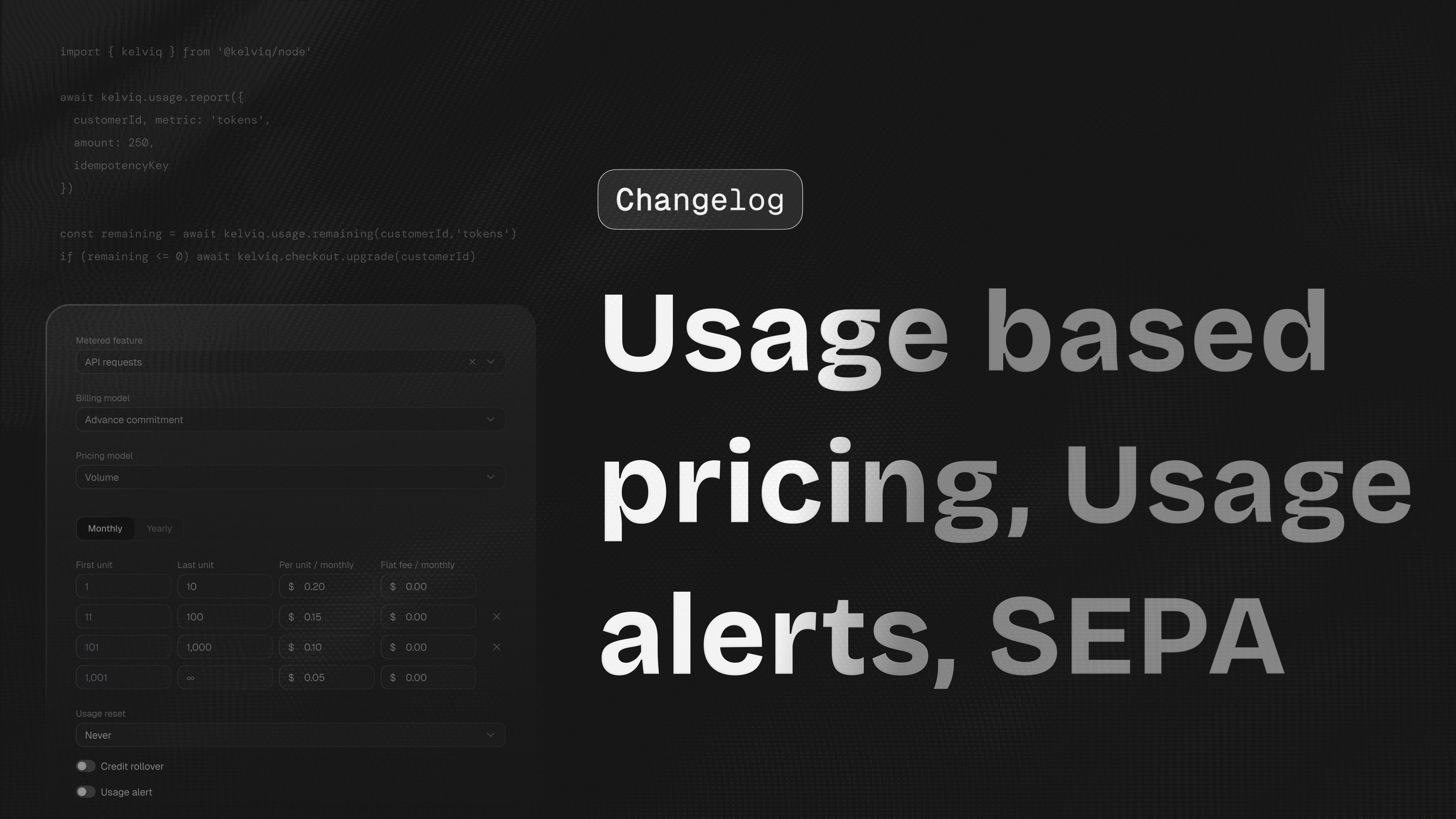
</Update>

<Update label="v1.8" description="June 5, 2026" tags={["App"]}>
  <img src="https://mintcdn.com/kelviq/clqYTjZFepJn_wWd/images/changelog/2026-06-05.png?fit=max&auto=format&n=clqYTjZFepJn_wWd&q=85&s=2a9217068fbf1919d42392d353a55901" alt="Kelviq release cover for June 5, 2026" width="5760" height="3240" data-path="images/changelog/2026-06-05.png" />

  ## Usage based pricing in the dashboard

  Merchants can configure metered pricing without leaving the dashboard. A plan can include a base subscription, included usage, and overage pricing for usage beyond the included amount.

  ## Pay as you go

  Kelviq now supports pay as you go pricing. Your customers can continue using a metered product after included usage runs out, then pay for additional consumption. This fits LLM tools, API platforms, transcription products, and image generation products where hard cutoffs create poor customer experiences.

  Example: A customer uses the following in one month:

  ```text theme={null}
  120,000 tokens
  40 image generations
  500 API calls
  ```

  Kelviq will calculate the bill based on the pricing rules you set.

  ## Enable pay as you go from the dashboard

  You can now enable pay as you go from the dashboard. This helps sellers launch usage based pricing without building their own billing system. A simple AI product can now charge like this:

  ```text theme={null}
  Base plan: $20 per month
  Included usage: 100,000 tokens
  Overage: $2 per 10,000 tokens
  ```

  ## Usage alerts

  Kelviq now supports usage alerts. Usage alerts help you know when a customer reaches an important usage threshold. Merchants can notify customers when metered usage crosses a configured limit. This is especially useful for AI products where usage can grow quickly across tokens, image generations, API calls, embeddings, storage, or compute minutes.

  Examples:

  * Customer used 80% of included credits
  * Customer crossed 10,000 API calls
  * Customer used more than `$100` in AI model cost
  * Customer is close to the monthly usage limit
  * Customer is likely to need an upgrade soon

  This helps sellers avoid surprise bills and give customers a better experience.

  ## Usage alerts for status entitlements

  Usage alerts now work with status entitlements. This helps connect product access with usage state.

  Example: A customer has `100` credits. Different features can consume credits differently:

  ```text theme={null}
  GPT 5.1 request: 2 credits
  Claude Sonnet request: 3 credits
  Page crawl: 5 credits
  Long report generation: 20 credits
  ```

  Kelviq can help track when the customer is close to the limit and trigger an alert.

  ## Negative usage values

  Usage reporting now supports negative values. This is useful when you need to correct usage after it was reported. If an app accidentally reports `125,000` tokens instead of `120,000`, it can send `-5,000` to bring the meter back in line.

  Examples:

  * Remove duplicate API usage
  * Reverse usage after a failed job
  * Credit back usage after a refund
  * Fix a metering mistake
  * Adjust token usage after an LLM call failed
  * Reserve tokens up front and return the unused amount once the action completes

  This also enables a reserve-and-settle pattern. You can block a number of tokens in advance, then report a negative value to return whatever wasn't used once the action finishes. For example, reserve `1,000` tokens before an LLM call, then send `-400` if only `600` were consumed.

  ```js theme={null}
  import { BEHAVIOUR_CHOICES } from '@kelviq/node-sdk';

  // Reserve tokens before the action
  await client.reporting.reportUsage({
    value: 1000,
    customerId: "cus_123",
    featureId: "tokens",
    behaviour: BEHAVIOUR_CHOICES.DELTA
  });

  // Return the unused tokens after it completes
  await client.reporting.reportUsage({
    value: -400,
    customerId: "cus_123",
    featureId: "tokens",
    behaviour: BEHAVIOUR_CHOICES.DELTA
  });
  ```

  ## Checkout API supports locked email and default billing country

  The checkout API now supports locked email and default billing country. This helps create a cleaner checkout flow when your app already knows the customer.

  Example:

  ```js theme={null}
  await client.checkout.createSession({
    planIdentifier: "plan-pro",
    customerId: "cust_789",
    lockEmail: true,
    defaultBillingCountry: "US"
  });
  ```

  This prevents customers from using the wrong email during checkout.

  ## Prefill customer email in checkout links

  Checkout links can now prefill the customer email when available. This is useful when checkout starts from your app.

  Example: A logged in customer clicks upgrade. Checkout opens with their email already filled in.

  ```text theme={null}
  alex@company.com
  ```

  This reduces checkout mistakes and support issues.

  ## Lock email using checkout config

  Checkout links now support locking the email field using config. This means customers can see the email but cannot edit it.

  This is useful for:

  * License keys
  * Account based access
  * Customer portal access
  * Subscription upgrades
  * Team plans

  ## SEPA payment method

  Checkout now supports SEPA. This helps sellers serve more European customers, especially B2B customers who prefer bank debit. SEPA is useful for:

  * SaaS subscriptions
  * B2B tools
  * Annual contracts
  * European customers
  * Larger invoice amounts
</Update>

<Update label="v2.6.0" description="June 5, 2026" tags={["Node SDK"]}>
  ### New Features

  #### Checkout Session — `metadata` Parameter

  `CreateCheckoutSessionPayload` now accepts an optional `metadata` field for attaching arbitrary key-value pairs to a checkout session. The metadata is returned verbatim on the `checkout.completed` webhook payload's `metadata` field, letting you correlate a completed checkout back to your own records.

  ```typescript theme={null}
  const response = await client.checkout.createSession({
    planIdentifier: "plan-pro-monthly",
    chargePeriod: "MONTHLY",
    customerId: "cust_789",
    successUrl: "https://example.com/success",
    metadata: {
      orderId: "order_12345",
      referralCode: "SUMMER2026",
    },
  });
  ```

  Unlike other payload fields, the **keys inside `metadata` are preserved exactly as provided** — they are not converted to snake\_case on the way to the API, so they survive the round-trip back through webhooks unchanged.
</Update>

<Update label="v2.6.0" description="June 5, 2026" tags={["Python SDK"]}>
  ### New Features

  #### Checkout Session — `metadata` Parameter

  `checkout.create_session()` now accepts an optional `metadata` parameter for attaching arbitrary key-value pairs to a checkout session. The metadata is returned verbatim on the `checkout.completed` webhook payload's `metadata` field, letting you correlate a completed checkout back to your own records.

  ```python theme={null}
  response = client.checkout.create_session(
      planIdentifier="plan-pro-monthly",
      chargePeriod="MONTHLY",
      customerId="cust_789",
      successUrl="https://example.com/success",
      metadata={
          "orderId": "order_12345",
          "referralCode": "SUMMER2026",
      },
  )
  ```

  **Async variant:**

  ```python theme={null}
  response = await async_client.checkout.create_session(
      planIdentifier="plan-pro-monthly",
      chargePeriod="MONTHLY",
      customerId="cust_789",
      successUrl="https://example.com/success",
      metadata={"orderId": "order_12345"},
  )
  ```

  The keys inside `metadata` are preserved exactly as provided — they are not transformed on the way to the API, so they survive the round-trip back through webhooks unchanged.
</Update>

<Update label="v1.7" description="May 29, 2026" tags={["App"]}>
  <img src="https://mintcdn.com/kelviq/clqYTjZFepJn_wWd/images/changelog/2026-05-29.png?fit=max&auto=format&n=clqYTjZFepJn_wWd&q=85&s=00a009352ec5b69601dfca2797970e0e" alt="Kelviq release cover for May 29, 2026" width="5760" height="3240" data-path="images/changelog/2026-05-29.png" />

  ## Tax inclusive pricing settings

  Kelviq now supports tax inclusive pricing settings. This lets you decide whether the price shown to the customer already includes tax.

  Example: A customer sees:

  ```text theme={null}
  $20 per month
  ```

  If tax inclusive pricing is enabled, the customer still pays \$20 per month.

  Kelviq calculates the tax portion from that amount. This is useful in markets where customers expect the displayed price to be the final price.

  ## Tax inclusive behavior is shown in checkout

  Checkout now respects tax inclusive settings so the buyer sees the same pricing behavior that was configured for the plan. This avoids the common confusion where a pricing page says `$49` but checkout unexpectedly adds tax on top.

  ## Tax type and tax percentage in checkout

  Checkout links now support tax type (such as VAT, GST, Sales Tax, or any other configured tax type) and the tax percentage. This gives customers a clearer view of what they are paying.

  Example with tax added on top:

  ```text theme={null}
  Product price: $100
  Tax: 10%
  Total: $110
  ```

  Example with tax included:

  ```text theme={null}
  Total: €20
  Includes tax: €3.33
  ```

  ## Tax behavior in plan details

  Plan detail pages now show tax behavior. Teams can confirm that a `Pro EU` plan includes VAT, while a `Pro US` plan remains tax exclusive. You can see whether a plan is tax inclusive or tax exclusive before sharing it with customers, helping you avoid setup mistakes.

  ## Tax code category on products

  You can now set a tax code category when creating or editing a product. This helps Kelviq apply the right tax treatment based on what you sell.

  Examples:

  * SaaS subscription
  * API access
  * AI credits
  * Digital download
  * License key
  * Course
  * Template
  * Plugin

  This matters because different product types can have different tax rules.

  ## Tax information in transactions

  Transaction views now show tax details so support and finance teams can answer customer questions without leaving the dashboard.

  You can use this to answer questions like:

  * What was the product price?
  * How much tax was charged?
  * Was tax included in the price?
  * What did the customer pay in total?

  ## Custom checkout pricing

  Kelviq now supports custom checkout pricing. This lets you create a checkout with a custom amount instead of always using the fixed public plan price.

  This is useful for:

  * Custom quotes
  * One off payments
  * Sales led plans
  * Manual upgrades
  * Private deals
  * Customer specific pricing

  Example: A customer agrees to a custom price of `$349 per month`.

  You can create a checkout session for that amount without creating a public plan for every custom price.

  ## Custom amount on checkout page

  Checkout can now show and charge a custom amount. This gives sellers more flexibility when dealing with larger customers or special pricing cases.

  Example:

  ```text theme={null}
  Custom plan
  $349 per month
  ```

  ## Regional pricing minimum value validation

  We added validation for regional pricing minimum values. This helps prevent a regional price from becoming too low to process.

  Example: A plan is priced at `$5`.

  A very large regional discount could reduce the price below the minimum amount allowed by the payment method. Kelviq now catches this earlier so sellers can fix it before customers reach checkout.

  ## Fixes

  **Canada postal code** —
  Fixed an issue with Canadian postal codes during checkout. Canadian postal codes such as `M5V 2T6` are now handled correctly.

  **Checkout plan switching** —
  Fixed an issue where checkout could fail when customers switched between plans. This improves checkout reliability when customers compare plans before paying.

  **Package pricing label** —
  Fixed the label for package based pricing. This makes package pricing easier for customers to understand at checkout.

  Example:

  ```text theme={null}
  $10 per 1,000 API calls
  ```

  **One time payment cancellation** —
  Fixed an issue where cancel subscription was visible for one time payments. One time payments do not have a subscription to cancel, so that action is now hidden.
</Update>

<Update label="v1.6" description="May 22, 2026" tags={["App"]}>
  <img src="https://mintcdn.com/kelviq/clqYTjZFepJn_wWd/images/changelog/2026-05-22.png?fit=max&auto=format&n=clqYTjZFepJn_wWd&q=85&s=a4fc8fbdad37123fca60f3b5bfa9b94c" alt="Kelviq release cover for May 22, 2026" width="5760" height="3240" data-path="images/changelog/2026-05-22.png" />

  ## Promotions are now faster and more reliable

  We moved Promotions storage to DynamoDB. This gives promotion rules
  a durable home across the dashboard, APIs, and hosted checkout.

  Example: A merchant selling an AI support agent can create `STARTUP20`,
  limit it to the Pro plan, and keep the rule available when checkout
  links are regenerated.

  ## Promotions are now available in the dashboard

  We added Promotions to the Kelviq dashboard. Teams can now create,
  review, and manage offers without asking engineering to touch config.
  The flow is built around what a billing owner actually needs to know:
  which plan is discounted, whether the promotion is active, and where
  the SDK docs are when you need to wire it up from code.

  A common flow looks like this:

  1. Create a product
  2. Create a plan
  3. Add a promotion
  4. Copy the checkout link
  5. Share the link or add it to your pricing page

  ## API and SDK docs are linked from Promotions

  The dashboard now connects promotion setup to the integration docs a developer needs when creating checkout sessions from the backend. This helps developers move from setup to integration faster.

  ## Checkout link empty screen is clearer

  The empty screen now points users toward creating or copying the right checkout link instead of leaving the page feeling broken.

  ## Checkout links are easier to access

  You can now get checkout links from product and plan listing pages. This saves time when you are setting up a product and want to quickly copy a checkout link.

  ## Product cards are now fully clickable

  Instead of clicking only on a small button or title, you can click anywhere on the product card to open it. This makes navigation easier when you have multiple products.

  ## Developers tab is now API Key

  We renamed the Developers tab to API Key. Most people go there to find their API key, so the label now matches the destination.

  Before: **Developers**

  Now: **API Key**

  ## Chart theming support

  We added theming options for charts, including branded and dark mode. Charts now stay consistent with the rest of your dashboard without manual workarounds.

  ## Analytics style update

  We updated the analytics UI style to make revenue, customers,
  transactions, and product data easier to scan.

  This is helpful when you want to quickly answer questions like:

  * How much did we sell today?
  * Which plan is performing better?
  * Which product has the most transactions?
  * Are refunds increasing?
  * Are more customers choosing annual plans?

  ## Docs copy cleanup

  We updated docs copy from `archive` to `delete` in more places.
  This makes the docs match the real product action.

  ## Fixes

  **Duplicate file upload issue** —
  Fixed an issue where duplicate files could be created during
  multiple file uploads.

  **Plan dialog issue** —
  Fixed an issue where the add plan dialog closed even when the
  user selected the option to create more plans. Now users can
  create multiple plans without reopening the dialog each time.

  **Feature delete issue** —
  Fixed an issue where a feature was not removed correctly from
  the list after deletion.
</Update>

<Update label="v1.5" description="May 15, 2026" tags={["App"]}>
  ### Payments & Billing

  * **UPI Payments Support** — You can now accept payments via UPI. Customers can pay seamlessly using their preferred UPI apps (like Google Pay, PhonePe, or Paytm).
  * **Usage-Based Billing** — You can now bill customers based on their actual consumption. This provides maximum flexibility for products using credits, seats, or data metrics.

  ### Customer Experience

  * **Signed Customer Portal Links** — Added the option to generate and send a signed customer portal link directly from the order details page for secure, instant access.

  ### Tax & Compliance

  * **Tax Information** — Tax detail is added in transaction.
  * **Tax Categories** — You can now define **Tax Categories** (B2B, B2C, Ebook, Online Course, etc.) during product creation.
  * **Business Tax ID Support** — Control how valid business tax IDs are handled for tax-inclusive pricing. When enabled, Kelviq automatically removes the included tax amount from the checkout total if a customer provides a valid business tax ID during checkout. When disabled, customers continue paying the listed tax-inclusive price with no tax deduction applied.
</Update>

<Update label="v2.5.0" description="May 10, 2026" tags={["Node SDK"]}>
  ### New Features

  #### Subscription Update — `trialEnd` Parameter

  `subscriptions.update()` now accepts an optional `trialEnd` field on `UpdateSubscriptionPayload` to control the trial period when updating a subscription.

  Pass either:

  * The literal string `"now"` to end any active trial immediately.
  * An ISO 8601 datetime string (e.g. `"2025-12-31T23:59:59Z"`) to set a new trial end date. The datetime must be in the future. Naive datetimes (no timezone designator) are interpreted as UTC.
  * Omit the field to preserve the existing trial behavior on the subscription.

  ```typescript theme={null}
  import { CHARGE_PERIOD_CHOICES } from '@kelviq/node-sdk';

  // End the trial now
  await client.subscriptions.update({
    subscriptionId: "sub_node_78058918",
    planIdentifier: "premium-plan-node",
    chargePeriod: CHARGE_PERIOD_CHOICES.MONTHLY,
    trialEnd: "now",
  });

  // Extend the trial to a specific future date
  await client.subscriptions.update({
    subscriptionId: "sub_node_78058918",
    planIdentifier: "premium-plan-node",
    chargePeriod: CHARGE_PERIOD_CHOICES.MONTHLY,
    trialEnd: "2025-12-31T23:59:59Z",
  });
  ```

  The SDK validates `trialEnd` client-side — invalid datetime strings or past datetimes throw `InvalidRequestError` before the request is sent.
</Update>

<Update label="v2.5.0" description="May 10, 2026" tags={["Python SDK"]}>
  ### New Features

  #### Subscription Update — `trialEnd` Parameter

  `subscriptions.update()` now accepts an optional `trialEnd` parameter to control the trial period when updating a subscription.

  Pass either:

  * The literal string `"now"` to end any active trial immediately.
  * An ISO 8601 datetime string (e.g. `"2025-12-31 23:59:59"`) to set a new trial end date. The datetime must be in the future. Naive datetimes are interpreted as UTC.
  * Omit the parameter to preserve the existing trial behavior on the subscription.

  ```python theme={null}
  # End the trial now
  response = client.subscriptions.update(
      subscriptionId="78058918-9746-4280-9b9b-1bd5115eec6e",
      planIdentifier="premium-plan",
      chargePeriod="MONTHLY",
      trialEnd="now",
  )

  # Extend the trial to a specific future date
  response = client.subscriptions.update(
      subscriptionId="78058918-9746-4280-9b9b-1bd5115eec6e",
      planIdentifier="premium-plan",
      chargePeriod="MONTHLY",
      trialEnd="2025-12-31 23:59:59",
  )
  ```

  **Async variant:**

  ```python theme={null}
  response = await async_client.subscriptions.update(
      subscriptionId="78058918-9746-4280-9b9b-1bd5115eec6e",
      planIdentifier="premium-plan",
      chargePeriod="MONTHLY",
      trialEnd="2025-12-31 23:59:59",
  )
  ```

  The SDK validates `trialEnd` client-side — invalid datetime strings or past datetimes raise `InvalidRequestError` before the request is sent.
</Update>

<Update label="v2.1.0" description="May 9, 2026" tags={["JS SDK"]}>
  ### New Features

  #### Product Offerings — Pricing API Support

  The SDK can now fetch and display product pricing data. Pass a `productId` to the client to enable pricing methods.

  ```ts theme={null}
  const client = kelviqSDK({
    productId: 'your-product-id',
    accessToken: 'your-access-token',
  });
  ```

  If `customerId` is also set, it is forwarded to the pricing API so the response reflects that customer's subscription state.

  ***

  ##### `fetchPricing(forceRefresh?)` — Fetch and Cache Pricing

  Fetches product offering data for the configured `productId`. Subsequent calls return the cached result unless `forceRefresh` is `true`.

  ```ts theme={null}
  const pricing = await client.fetchPricing();
  console.log(pricing.plans, pricing.currencyCode, pricing.billingPeriods);
   
  await client.fetchPricing(true); // bypass cache
  ```

  ##### `getPricing()` — Read from Cache

  Returns cached pricing data synchronously, or `null` if not yet fetched.

  ```ts theme={null}
  const pricing = client.getPricing();
  ```

  ##### `getPlan(identifier)` — Look Up a Single Plan

  Finds an enabled plan by identifier from the pricing cache. Returns `null` if not found or pricing hasn't been fetched.

  ```ts theme={null}
  const plan = client.getPlan('pro-plan');
  console.log(plan?.displayName, plan?.price.priceType);
  ```

  ##### `isPricingLoading()` — Loading State

  Returns `true` while a pricing fetch is in progress.

  ```ts theme={null}
  if (client.isPricingLoading()) { /* show spinner */ }
  ```

  ##### `getLastPricingError()` — Error State

  Returns the last `Error` from a failed pricing fetch, or `null`.

  ```ts theme={null}
  const err = client.getLastPricingError();
  ```

  ##### `clearPricingCache()` — Reset Cache

  Clears cached pricing data and resets loading and error states.

  ```ts theme={null}
  client.clearPricingCache();
  ```

  ***

  ##### `renderPricing(options?)` — DOM Binding

  Scans the DOM for elements with `data-kq-price` attributes and populates them with localized formatted prices. Requires pricing data to be fetched first.

  ```html theme={null}
  <span data-kq-price="pro-plan" data-kq-period="MONTHLY">Loading...</span>
  ```

  ```ts theme={null}
  await client.fetchPricing();
  client.renderPricing();
   
  // Scope to a container
  client.renderPricing({ container: document.getElementById('pricing-section') });
   
  // With format options
  client.renderPricing({ formatOptions: { compact: true } });
  ```

  | Attribute        | Required | Description                                                                          |
  | ---------------- | -------- | ------------------------------------------------------------------------------------ |
  | `data-kq-price`  | Yes      | Plan identifier                                                                      |
  | `data-kq-period` | No       | Billing period (e.g. `MONTHLY`, `YEARLY`). Falls back to the first available charge. |

  ***

  ##### `kqFormatPrice(amount, currencySymbol, options?)` — Price Formatter

  Standalone named export for formatting a numeric amount with a currency symbol.

  ```ts theme={null}
  import { kqFormatPrice } from '@kelviq/js-sdk';
   
  kqFormatPrice(9.99, '$', { pricingLocale: 'en-US' });                  // "$9.99"
  kqFormatPrice(1200, '€', { compact: true, pricingLocale: 'de-DE' });   // "€1,2K"
  kqFormatPrice(9.99, '$', { includeCurrencySymbol: false });             // "9.99"
  ```

  | Option                  | Type      | Default         | Description                           |
  | ----------------------- | --------- | --------------- | ------------------------------------- |
  | `compact`               | `boolean` | `false`         | Use compact notation (e.g. `1.2K`)    |
  | `locale`                | `string`  | `pricingLocale` | Override locale for number formatting |
  | `pricingLocale`         | `string`  | `'en-US'`       | Locale from the pricing API           |
  | `includeCurrencySymbol` | `boolean` | `true`          | Prepend the currency symbol           |

  ***

  ##### New Types and Exports

  ```ts theme={null}
  export { kqFormatPrice } from './formatPrice';
  export type { KQFormatPriceOptions } from './formatPrice';
  export type {
    RawPricingFeature,
    RawPricingCharge,
    RawPricingPrice,
    RawPricingPlan,
    RawPricingBillingPeriod,
    RawPricingApiResponse,
  } from './types';
  ```
</Update>

<Update label="v2.1.1" description="May 9, 2026" tags={["React SDK"]}>
  ### Improvements

  #### `KelviqProvider` — `customerId` and `plansEnabled` Props for Pricing

  The pricing request now forwards two additional optional props to the product offerings API.

  **`customerId`** — when provided, the pricing response is personalized to that customer (e.g. reflecting their existing subscription state):

  ```tsx theme={null}
  <KelviqProvider
    accessToken="..."
    productId="your-product-id"
    customerId="cust_123"
    config={{ fetchPricingOnMount: true }}
  >
    <App />
  </KelviqProvider>
  ```

  **`plansEnabled`** — a comma-separated list of plan identifiers to include in the response. When omitted, all active plans are returned:

  ```tsx theme={null}
  <KelviqProvider
    accessToken="..."
    productId="your-product-id"
    plansEnabled="free-plan,pro-plan"
    config={{ fetchPricingOnMount: true }}
  >
    <App />
  </KelviqProvider>
  ```

  Both props are reactive — updating either value will trigger a new pricing fetch automatically.
</Update>

<Update label="v2.1.0" description="May 9, 2026" tags={["React SDK"]}>
  ### New Features

  #### Product Offerings — Pricing & Feature Components

  The SDK now supports fetching and displaying product pricing and plan features, with localized currency based on user location.

  ##### Setup

  Pass `productId` and enable `fetchPricingOnMount` in your provider config:

  ```tsx theme={null}
  <KelviqProvider
    accessToken="..."
    productId="your-product-id"
    config={{ fetchPricingOnMount: true }}
  >
    <App />
  </KelviqProvider>
  ```

  ##### `usePricing()` — Pricing Data Hook

  Returns the full pricing API response as an `AsyncState`. Only populated when `fetchPricingOnMount` is enabled, or after calling `refreshPricing()` from `useKelviq()`.

  ```ts theme={null}
  const { data, isLoading, error } = usePricing();
  console.log(data?.currencyCode, data?.plans);
  ```

  ##### `<KQPrice />` — Render-Prop Price Component

  Displays localized pricing for a plan and billing period:

  ```tsx theme={null}
  <KQPrice
    planIdentifier="pro-plan"
    billingPeriod="MONTHLY"
    loadingComponent={<Spinner />}
    fallback={<p>Unavailable</p>}
  >
    {({ formattedPrice, isFree, hasFreeTrial, trialPeriod }) => (
      <div>
        <span>{formattedPrice}</span>
        {hasFreeTrial && <span>Try free for {trialPeriod} days</span>}
      </div>
    )}
  </KQPrice>
  ```

  The render prop receives:

  | Field            | Type                       | Description                                       |
  | ---------------- | -------------------------- | ------------------------------------------------- |
  | `plan`           | `RawPricingPlan`           | Full plan object                                  |
  | `charge`         | `RawPricingCharge \| null` | Charge for the requested billing period           |
  | `amount`         | `number`                   | Raw numeric amount                                |
  | `formattedPrice` | `string`                   | Localized price string (e.g. `$9.99`) or `"Free"` |
  | `currencySymbol` | `string`                   | e.g. `$`                                          |
  | `currencyCode`   | `string`                   | e.g. `USD`                                        |
  | `pricingLocale`  | `string`                   | e.g. `en-US`                                      |
  | `isFree`         | `boolean`                  | `true` when `priceType === 'FREE'`                |
  | `hasFreeTrial`   | `boolean`                  | Whether a free trial is available                 |
  | `trialPeriod`    | `number`                   | Trial length in days                              |

  ##### `<KQFeatureList />` — Render-Prop Feature Component

  Iterates over enabled features for a plan. Supports optional filtering by feature type:

  ```tsx theme={null}
  <KQFeatureList
    planIdentifier="pro-plan"
    featureType="BOOLEAN"
    loadingComponent={<Spinner />}
    fallback={<p>No features available</p>}
  >
    {({ feature, plan, index }) => (
      <li key={feature.id}>
        {feature.displayName}
      </li>
    )}
  </KQFeatureList>
  ```

  | Prop               | Type                   | Description                                    |
  | ------------------ | ---------------------- | ---------------------------------------------- |
  | `planIdentifier`   | `string`               | The plan to list features for                  |
  | `featureType`      | `'BOOLEAN' \| 'METER'` | Optional filter by feature type                |
  | `loadingComponent` | `ReactNode`            | Shown while data loads                         |
  | `fallback`         | `ReactNode`            | Shown when plan not found or no features match |
  | `children`         | `(data) => ReactNode`  | Render prop called for each enabled feature    |

  ##### `kqFormatPrice()` — Price Formatter Utility

  Standalone utility for formatting a numeric amount with a currency symbol:

  ```ts theme={null}
  import { kqFormatPrice } from '@kelviq/react-sdk';
   
  kqFormatPrice(9.99, '$', { pricingLocale: 'en-US' });         // "$9.99"
  kqFormatPrice(1200, '€', { compact: true, pricingLocale: 'de-DE' }); // "€1,2K"
  kqFormatPrice(0, '$', { includeCurrencySymbol: false });       // "0"
  ```

  | Option                  | Type      | Default         | Description                           |
  | ----------------------- | --------- | --------------- | ------------------------------------- |
  | `compact`               | `boolean` | `false`         | Use compact notation (e.g. `1.2K`)    |
  | `locale`                | `string`  | `pricingLocale` | Override locale for number formatting |
  | `pricingLocale`         | `string`  | `'en-US'`       | Locale from the pricing API           |
  | `includeCurrencySymbol` | `boolean` | `true`          | Prepend the currency symbol           |

  ##### New Types

  ```ts theme={null}
  RawPricingFeature
  RawPricingCharge
  RawPricingPrice
  RawPricingPlan
  RawPricingBillingPeriod
  RawPricingApiResponse
   
  KQFormatPriceOptions
  KQPriceProps
  KQFeatureListProps
  ```

  ##### New Exports

  ```ts theme={null}
  export { usePricing } from './hooks/usePricing';
  export { KQPrice } from './components/KQPrice';
  export { KQFeatureList } from './components/KQFeatureList';
  export { kqFormatPrice } from './utils/formatPrice';
  export type * from './types/api.types';
  ```
</Update>

<Update label="v0.0.4" description="May 7, 2026" tags={["JS Promotions UI"]}>
  ### Changed

  #### Close Icon Update

  The close icon across all promotion UI components has been updated for better visibility and brand alignment. This change ensures a more consistent user experience when dismissing active promotions.
</Update>

<Update label="v1.1.0" description="May 7, 2026" tags={["API"]}>
  ### New Features

  #### Enhanced Checkout Configuration

  You can now pass additional configuration parameters when [creating a checkout session via the API](https://docs.kelviq.com/api-reference/checkout/create-a-checkout-session). These new fields allow for tighter control over the customer experience:

  * **`lockEmail`**: When set to `true`, the email address field on the checkout page is disabled, preventing customers from changing the email associated with the session.
  * **`discountsEnabled`**: A boolean to explicitly allow or disallow discount code application on the checkout page.
  * **`defaultBillingCountry`**: Pre-fills the billing country field (e.g., `"IN"`).

  **Example Payload:**

  ```json theme={null}
  {
    "planIdentifier": "base",
    "successUrl": "[https://kelviq.com/checkout/success](https://kelviq.com/checkout/success)",
    "chargePeriod": "MONTHLY",
    "customerId": "sachin",
    "lockEmail": true,
    "discountsEnabled": false,
    "defaultBillingCountry": "IN"
  }
  ```
</Update>

<Update label="v1.0.0" description="May 7, 2026" tags={["API"]}>
  ### New Features

  #### Custom Dynamic Amount Support

  Added support for custom dynamic amounts on the checkout page. You can now pass a specific `custom_amount` directly via the checkout API, which is ideal for usage-based, variable, or custom-quoted pricing models.

  * **`custom_amount`**: The specific numeric amount to be charged to the customer. This overrides static plan pricing and is ideal for usage-based, variable, or custom-quoted pricing models.

  * **`tax_behavior`**: Specifies how taxes should be applied to the custom amount. For example, setting it to "INCLUSIVE" means the tax is already factored into the custom\_amount, while "EXCLUSIVE" would add the tax on top of the base amount.

  * **`currency_code`**: The three-letter ISO currency code (e.g., "INR", "USD") that defines the currency in which the custom\_amount should be processed.

  ```json theme={null}
  {
    "planIdentifier": "automatic-pricing",
    "successUrl": "[https://www.kelviq.com/](https://www.kelviq.com/)",
    "chargePeriod": "MONTHLY",
    "customerId": "sam-altman0010",
    "custom_amount": 1200,
    "tax_behavior": "INCLUSIVE",
    "currency_code": "INR"
  }
  ```
</Update>

<Update label="v1.4" description="May 04, 2026" tags={["App"]}>
  ### Platform Improvements

  * **Webhook Enhancements** — New webhook options in settings, including **Webhook Logs** for easier debugging and a new **Plan Changed** webhook event.
  * **Analytics Refresh** — The analytics dashboard has a fresh new look for better data visualization and clarity.
  * **Early Payout Access** — The Payouts tab is now enabled even before business verification is complete, allowing you to prepare your financial setup easily.

  ### Fixes

  * **File Uploads** — Resolved an issue that caused duplicate files to be created during multiple file uploads.
</Update>

<Update label="v2.4.0" description="May 4, 2026" tags={["Node SDK"]}>
  ### New Features

  #### Checkout Session — New Optional Parameters

  Three new optional fields on `CreateCheckoutSessionPayload` give you more control over the hosted checkout page.

  **`discountsEnabled`** — controls whether the coupon/discount code field is shown. Defaults to `true`.

  **`lockEmail`** — when `true`, the email field is pre-filled and locked so the customer cannot change it. Defaults to `false`.

  **`defaultBillingCountry`** — ISO 3166-1 alpha-2 country code (e.g. `"US"`, `"GB"`) used to pre-fill the billing address country field.

  ```typescript theme={null}
  const response = await client.checkout.createSession({
    planIdentifier: "plan-pro-monthly",
    chargePeriod: "MONTHLY",
    customerId: "cust_789",
    successUrl: "https://example.com/success",
    discountsEnabled: false,
    lockEmail: true,
    defaultBillingCountry: "US",
  });
  ```
</Update>

<Update label="v2.4.0" description="May 4, 2026" tags={["Python SDK"]}>
  ### New Features

  #### Checkout Session — New Optional Parameters

  Three new optional parameters on `checkout.create_session()` give you more control over the hosted checkout page.

  **`discounts_enabled`** — controls whether the coupon/discount code field is shown. Defaults to `True` on the server.

  **`lock_email`** — when `True`, the email field is pre-filled and locked so the customer cannot change it. Defaults to `False`.

  **`default_billing_country`** — ISO 3166-1 alpha-2 country code (e.g. `"US"`, `"GB"`) used to pre-fill the billing address country field.

  ```python theme={null}
  response = client.checkout.create_session(
      planIdentifier="plan-pro-monthly",
      chargePeriod="MONTHLY",
      customerId="cust_789",
      successUrl="https://example.com/success",
      discountsEnabled=False,
      lockEmail=True,
      defaultBillingCountry="US",
  )
  ```

  **Async variant:**

  ```python theme={null}
  response = await async_client.checkout.create_session(
      planIdentifier="plan-pro-monthly",
      chargePeriod="MONTHLY",
      customerId="cust_789",
      successUrl="https://example.com/success",
      discountsEnabled=False,
      lockEmail=True,
      defaultBillingCountry="US",
  )
  ```
</Update>

<Update label="v2.3.0" description="April 25, 2026" tags={["Node SDK"]}>
  ### New Features

  #### Webhook Verification

  A new `validateEvent` helper lets you securely verify incoming webhook requests from Kelviq in one step. It validates the HMAC-SHA256 signature using the three headers Kelviq attaches to every webhook delivery, then returns the parsed event object.

  ```typescript theme={null}
  import { validateEvent, WebhookVerificationError } from '@kelviq/node-sdk';
  import express from 'express';

  const app = express();

  app.post('/webhook', express.raw({ type: 'application/json' }), (req, res) => {
    try {
      const event = validateEvent(
        req.body,
        req.headers,
        '<YOUR_WEBHOOK_SECRET>',
      );

      // Process the event
      console.log('Event type:', event.type);

      res.sendStatus(202);
    } catch (err) {
      if (err instanceof WebhookVerificationError) {
        return res.sendStatus(403);
      }
      throw err;
    }
  });
  ```

  **`validateEvent(payload, headers, secret)`**

  * `payload` — Raw request body as a `string` or `Buffer`. Must be the unparsed body — do not pass a pre-parsed JSON object.
  * `headers` — The request headers object (e.g. `req.headers` in Express). Header lookup is case-insensitive.
  * `secret` — Your webhook signing secret (`kq_whsec_...`) from the Kelviq dashboard.

  Returns the parsed event as `Record<string, unknown>`. Throws `WebhookVerificationError` if a required header is missing, the signature format is invalid, or the signature does not match.

  #### `WebhookVerificationError`

  New error class thrown by `validateEvent` when verification fails. Extends `Error`.
</Update>

<Update label="v2.3.0" description="April 25, 2026" tags={["Python SDK"]}>
  ### New Features

  #### Webhook Verification

  A new `validate_event` helper lets you securely verify incoming webhook requests from Kelviq in one step. It validates the HMAC-SHA256 signature using the three headers Kelviq attaches to every webhook delivery, then returns the parsed event dictionary.

  ```python theme={null}
  from flask import Flask, request
  from kelviq_sdk import validate_event, WebhookVerificationError

  app = Flask(__name__)

  @app.route('/webhook', methods=['POST'])
  def webhook():
      try:
          event = validate_event(
              payload=request.data,
              headers=request.headers,
              secret='<YOUR_WEBHOOK_SECRET>',
          )

          # Process the event
          print('Event type:', event.get('type'))

          return "", 202
      except WebhookVerificationError as e:
          return "", 403
  ```

  **`validate_event(payload, headers, secret)`**

  * `payload` — Raw request body as `bytes` or `str`. Must be the unparsed body — do not pass a pre-parsed dictionary.
  * `headers` — Any mapping of header name to value (e.g. `request.headers` in Flask). Header lookup is case-insensitive.
  * `secret` — Your webhook signing secret (`kq_whsec_...`) from the Kelviq dashboard.

  Returns the parsed event as `Dict[str, Any]`. Raises `WebhookVerificationError` if a required header is missing, the signature format is invalid, or the signature does not match.

  #### `WebhookVerificationError`

  New exception class raised by `validate_event` when verification fails. Extends `Exception`.
</Update>

<Update label="v1.3" description="April 22, 2026" tags={["App"]}>
  ### New Features

  * **Promotions** — A new framework for managing promotional offers and campaigns directly within the dashboard.
  * **Tax Information in Transactions** — Detailed tax breakdowns are now included in transaction records, providing full transparency for accounting.
  * **Zapier Integration** — Connect Kelviq with thousands of other apps. Automate your workflow by triggering actions in external tools whenever a subscription or payment event occurs.
</Update>

<Update label="v2.2.0" description="April 13, 2026" tags={["Node SDK"]}>
  ### New Features

  #### License Management Module

  A new `client.license` module provides full lifecycle management for software licenses.

  **`license.activate({ licenseKey, customerId?, instanceName?, metadata? })`**

  Activates a license key and creates a new instance. Returns a `LicenseActivateResponse` containing the `instanceId`, `activatedAt`, `expiresOn`, and the full `LicenseDetails` object.

  ```typescript theme={null}
  const response = await client.license.activate({
      licenseKey: "LIC-XXXX-YYYY-ZZZZ",
      customerId: "cust_789",
      instanceName: "My MacBook Pro",
      metadata: { os: "macOS", arch: "arm64" },
  });

  console.log(response.instanceId);
  console.log(response.license.activationUsage); // e.g. 1
  console.log(response.license.plan.product.name); // e.g. "Kelviq Engine"
  ```

  **`license.deactivate({ licenseKey, instanceId })`**

  Deactivates a specific license instance. Returns a `LicenseDeactivateResponse` with `message` and `deactivatedAt`.

  ```typescript theme={null}
  const response = await client.license.deactivate({
      licenseKey: "LIC-XXXX-YYYY-ZZZZ",
      instanceId: "8f3e2b1a-5c6d-4e9f-8a0b-1c2d3e4f5g6h",
  });
  console.log(response.message); // "License instance deactivated successfully."
  ```

  **`license.validate({ licenseKey, instanceId? })`**

  Validates a license key and optionally a specific instance. Returns a `LicenseValidateResponse` with `valid`, `code`, `detail`, `metadata`, and the full `LicenseDetails`.

  ```typescript theme={null}
  const response = await client.license.validate({
      licenseKey: "LIC-XXXX-YYYY-ZZZZ",
      instanceId: "8f3e2b1a-5c6d-4e9f-8a0b-1c2d3e4f5g6h",
  });

  if (response.valid) {
      console.log(`Valid — code: ${response.code}`);
  } else {
      console.log(`Invalid — ${response.detail}`);
  }
  ```

  #### New TypeScript Interfaces

  * **`LicenseDetails`** — Full license object with `id`, `licenseKey`, `activatedOn`, `expiresOn`, `activationUsage`, `activationLimit`, `enabled`, `customer`, `plan`, and `subscription`.
  * **`LicenseCustomer`** — `{ customerId, name?, email? }` nested in `LicenseDetails`.
  * **`LicensePlan`** — Expanded with `description`, `version`, `isLatest`, and `product` (nested `LicensePlanProduct`).
  * **`LicensePlanProduct`** — `{ id, identifier, name, taxCode?, createdOn?, modifiedOn? }`.
  * **`LicenseActivateResponse`**, **`LicenseDeactivateResponse`**, **`LicenseValidateResponse`** — Typed responses for each operation.

  #### `SubscriptionData` New Fields

  Three new fields derived from the subscription's `recurrence` string are now included in `SubscriptionData` (returned within `LicenseDetails.subscription` and customer subscription summaries):

  * **`billingType`** — `"SUBSCRIPTION"` if the plan has a recurrence, `"ONE_TIME"` otherwise.
  * **`recurrenceUnit`** — Integer unit from the recurrence string (e.g. `1` from `"1 month"`), or `null`.
  * **`recurrenceType`** — Recurrence period in uppercase (e.g. `"MONTH"`), or `null`.
</Update>

<Update label="v2.2.0" description="April 13, 2026" tags={["Python SDK"]}>
  ### New Features

  #### License Management Module

  A new `client.license` module provides full lifecycle management for software licenses. All methods are available in both synchronous and asynchronous clients.

  **`license.activate(licenseKey, customerId?, instanceName?, metadata?)`**

  Activates a license key and creates a new instance. Returns a `LicenseActivateResponse` (Pydantic model) containing the `instanceId`, `activatedAt`, `expiresOn`, and the full `LicenseDetails` object.

  ```python theme={null}
  response = client.license.activate(
      licenseKey="LIC-XXXX-YYYY-ZZZZ",
      customerId="cust_789",
      instanceName="My MacBook Pro",
      metadata={"os": "macOS", "arch": "arm64"},
  )

  print(response.instanceId)
  print(response.license.activationUsage)       # e.g. 1
  print(response.license.plan.product.name)     # e.g. "Kelviq Engine"
  print(response.license.subscription.billingType)  # "SUBSCRIPTION"
  ```

  **`license.deactivate(licenseKey, instanceId)`**

  Deactivates a specific license instance. Returns a `LicenseDeactivateResponse` with `message` and `deactivatedAt`.

  ```python theme={null}
  response = client.license.deactivate(
      licenseKey="LIC-XXXX-YYYY-ZZZZ",
      instanceId="8f3e2b1a-5c6d-4e9f-8a0b-1c2d3e4f5g6h",
  )
  print(response.message)  # "License instance deactivated successfully."
  ```

  **`license.validate(licenseKey, instanceId?)`**

  Validates a license key and optionally a specific instance. Returns a `LicenseValidateResponse` with `valid`, `code`, `detail`, `metadata`, and the full `LicenseDetails`.

  ```python theme={null}
  response = client.license.validate(
      licenseKey="LIC-XXXX-YYYY-ZZZZ",
      instanceId="8f3e2b1a-5c6d-4e9f-8a0b-1c2d3e4f5g6h",
  )

  if response.valid:
      print(f"Valid — code: {response.code}")
  else:
      print(f"Invalid — {response.detail}")
  ```

  #### New Pydantic Models

  * **`LicenseDetails`** — Full license object with `id`, `licenseKey`, `activatedOn`, `expiresOn`, `activationUsage`, `activationLimit`, `enabled`, `customer`, `plan`, and `subscription`.
  * **`LicenseCustomer`** — `customerId`, `name`, `email` nested within `LicenseDetails`.
  * **`LicensePlan`** — Expanded with `description`, `version`, `isLatest`, and `product` (nested `LicensePlanProduct` model).
  * **`LicensePlanProduct`** — `id`, `identifier`, `name`, `taxCode`, `createdOn`, `modifiedOn`.
  * **`LicenseActivateResponse`**, **`LicenseDeactivateResponse`**, **`LicenseValidateResponse`** — Typed Pydantic response models for each operation.

  #### `SubscriptionData` New Fields

  Three new fields derived from the subscription's `recurrence` string are now included in `SubscriptionData` (returned within `LicenseDetails.subscription` and customer subscription summaries):

  * **`billingType`** — `"SUBSCRIPTION"` if the plan has a recurrence, `"ONE_TIME"` otherwise.
  * **`recurrenceUnit`** — Integer unit from the recurrence string (e.g. `1` from `"1 month"`), or `None`.
  * **`recurrenceType`** — Recurrence period in uppercase (e.g. `"MONTH"`), or `None`.
</Update>

<Update label="v1.2" description="April 10, 2026" tags={["App"]}>
  ### Improvements

  * **Webhooks Foundation** — Added initial webhook configuration options within the settings menu to prepare for advanced automation.
  * **Product UI Refinement** — The entire product card is now clickable for faster navigation, and we've added field validation for regional pricing minimum values.
</Update>

<Update label="v2.1.0" description="April 2, 2026" tags={["Node SDK"]}>
  ### New Features

  #### Customer Portal Module

  A new `client.portal` module lets you create pre-authenticated customer portal sessions server-side and redirect customers directly to their self-serve portal.

  **`portal.createSession({ customerId })`**

  ```typescript theme={null}
  const session = await client.portal.createSession({
      customerId: "cust_789",
  });

  // Redirect the customer — no login required
  res.redirect(session.customerPortalUrl);
  ```

  Returns `CreatePortalSessionResponse` with:

  * `token` — Session token authenticating the portal session.
  * `email` — The customer's email address.
  * `customerPortalUrl` — Pre-authenticated URL to redirect the customer to.
</Update>

<Update label="v2.1.0" description="April 2, 2026" tags={["Python SDK"]}>
  ### New Features

  #### Customer Portal Module

  A new `client.portal` module lets you create pre-authenticated customer portal sessions server-side and redirect customers directly to their self-serve portal. Available on both synchronous and asynchronous clients.

  **`portal.create_session(customerId)`**

  ```python theme={null}
  session = client.portal.create_session(customerId="cust_789")

  # Redirect your customer — no login required
  print(session.customerPortalUrl)
  ```

  **Async variant:**

  ```python theme={null}
  session = await async_client.portal.create_session(customerId="cust_789")
  ```

  Returns `CreatePortalSessionResponse` (Pydantic model) with:

  * `token` (str) — Session token authenticating the portal session.
  * `email` (str) — The customer's email address.
  * `customerPortalUrl` (str) — Pre-authenticated URL to redirect the customer to.
</Update>

<Update label="v1.1" description="February 27, 2026" tags={["App"]}>
  ### New Features

  * **Multiple subscriptions per customer** — Kelviq now supports customers having multiple active subscriptions. Use this to set up add-ons, credit packs, or top-ups alongside a base plan. Our SDKs automatically aggregate entitlements across all subscriptions, so your app always sees the correct combined usage and limits.
  * **New Subscriptions page** — A dedicated page to view and manage all subscriptions in one place.
  * **New Payout Details page** — View detailed breakdowns for individual payouts.
  * **Transactions & Details page under Payouts** — Browse all payout transactions with a detail view for each entry.
  * **Discount coupons on checkout URLs** — You can now attach discount coupons directly to checkout URLs, allowing you to share pre-discounted links with customers.
  * **Block size 1 for package pricing** — Package pricing now supports a block size of 1, giving you more granular control over package-based plans.
  * **Updated Publish modal UI** — The publish modal has been redesigned for a cleaner, more intuitive experience.

  ### Improvements

  * **Flat & package pricing for one-time charges** — Flat-rate and package pricing models are now available for one-time products, not just recurring plans.
  * **Copy charge period on hover** — Hover over a charge period in the pricing section to quickly copy it to your clipboard.
  * **Plan details page UI improvements** — The plan details page has been refreshed with a cleaner layout and better readability.
  * **Improved refund error messages** — Refund errors now include clearer descriptions to help you understand what went wrong.
  * **Improved Analytics UI** — The analytics dashboard has been updated with a more polished interface.
  * **Download invoice in subscription detail page** — You can now download invoices directly from any subscription's detail page.
  * **Cancel subscription from customer detail page** — Added the ability to cancel a customer's subscription directly from their detail page without navigating away.

  ### Fixes

  * **Entitlements override indicator** — Fixed an issue where entitlements were incorrectly shown as "overridden" in the UI when the values hadn't actually changed during feature copying.
  * **Refund button disabled when not applicable** — The refund payment button is now correctly disabled when a payment has already been refunded or the subscription is in a trial period.
  * **Billing info badge for one-time orders** — Fixed the billing info badge not appearing for one-time orders in the order list and detail pages.
</Update>

<Update label="v2.0.0" description="February 27, 2026" tags={["JS SDK"]}>
  ### New Features

  #### Hybrid Aggregation Engine

  If a customer has multiple subscriptions (e.g., a base plan + a top-up), the API may return duplicate `featureId` entries. The SDK now automatically aggregates them into a single `Entitlement` object per feature — no manual merging required.

  **Aggregation rules:**

  | Feature Type     | `hasAccess`                            | `currentUsage`     | `usageLimit`       | `hardLimit`                |
  | ---------------- | -------------------------------------- | ------------------ | ------------------ | -------------------------- |
  | **METER**        | `true` if `remaining > 0` or unlimited | Summed             | Summed             | `true` if any item sets it |
  | **BOOLEAN**      | `true` if any item grants access       | `0`                | `null`             | `false`                    |
  | **CUSTOMIZABLE** | `true` if any item grants access       | First item's value | First item's value | First item's value         |

  Per-item details (like `resetAt` and individual `hardLimit` values) are available on `entitlement.items[]`.

  #### `getEntitlements()` — Fetch All Entitlements

  Returns all aggregated entitlements as a map keyed by `featureId`. Replaces the old `getAllEntitlements()` method.

  ```typescript theme={null}
  const entitlements = kq.getEntitlements();
  // { "email-sends": Entitlement, "api-calls": Entitlement, ... }
  ```

  #### `getRawEntitlement(featureId)` — Raw Data for a Single Feature

  Returns the un-aggregated raw API items for a specific `featureId`. Useful when you need per-subscription details.

  ```typescript theme={null}
  const rawItems = kq.getRawEntitlement("email-sends");
  // [{ featureId: 'email-sends', featureType: 'METER', hasAccess: true, ... }, ...]
  ```

  #### `getRawEntitlements()` — Full Raw API Response

  Returns the complete raw API response including the `customerId` wrapper, before any aggregation.

  ```typescript theme={null}
  const raw = kq.getRawEntitlements();
  // { customerId: 'cust_123', entitlements: [...] }
  ```

  #### `ready()` — Wait for Initial Fetch

  Returns a promise that resolves once the initial entitlement fetch completes. If `initializeAndFetch` was not set, resolves immediately.

  ```typescript theme={null}
  const kq = kelviqSDK({
    customerId: "cust_123",
    accessToken: "your-access-token",
  });

  await kq.ready();
  // Entitlements are now available
  const emails = kq.getEntitlement("email-sends");
  console.log(emails.hasAccess, emails.remaining);
  ```

  #### New Type Exports

  `RawEntitlement` and `RawEntitlementsApiResponse` are now exported for consumers who need to type the raw API objects in their own code.

  ***

  ### Breaking Changes

  #### Unified `Entitlement` Interface

  The separate `BooleanEntitlement`, `ConfigEntitlement`, and `MeteredEntitlement` types have been replaced with a single, unified `Entitlement` interface:

  ```typescript theme={null}
  interface Entitlement {
    featureId: string;
    featureType: "METER" | "BOOLEAN" | "CUSTOMIZABLE";
    hasAccess: boolean;      // true if at least one item grants access
    hardLimit: boolean;      // true if any item has hardLimit set
    currentUsage: number;    // SUM of all items' currentUsage (METER only)
    usageLimit: number | null; // SUM of all items' usageLimit (METER only)
    remaining: number | null;  // usageLimit - currentUsage
    items: RawEntitlement[];   // Original API objects for this featureId
  }
  ```

  **Migration:** Replace all references to `BooleanEntitlement`, `ConfigEntitlement`, `MeteredEntitlement`, and `AnyEntitlement` with `Entitlement`.

  #### `getEntitlement()` No Longer Accepts a Type Argument

  The generic type parameter and second `type` argument have been removed. The SDK now determines the feature type automatically.

  ```typescript theme={null}
  // Before
  const emailQuota = kq.getEntitlement<MeteredEntitlement>("email-sends", "metered");
  console.log(emailQuota.used, emailQuota.limit);

  // After
  const emailQuota = kq.getEntitlement("email-sends");
  console.log(emailQuota.currentUsage, emailQuota.usageLimit);
  ```

  #### Renamed Fields

  | Before          | After          | Notes                                                                    |
  | --------------- | -------------- | ------------------------------------------------------------------------ |
  | `used`          | `currentUsage` | Aligned with the raw API field name                                      |
  | `limit`         | `usageLimit`   | Aligned with the raw API field name                                      |
  | `type`          | `featureType`  | Now uses uppercase API values (`"METER"`, `"BOOLEAN"`, `"CUSTOMIZABLE"`) |
  | `configuration` | *(removed)*    | No longer surfaced at the top level                                      |
  | `resetAt`       | *(removed)*    | Access via `entitlement.items[].resetAt` (may differ per subscription)   |

  #### Removed Exports

  The following types are no longer exported:

  * `BooleanEntitlement`, `ConfigEntitlement`, `MeteredEntitlement`, `AnyEntitlement`
  * `EntitlementMap` is now `Record<string, Entitlement>` (no union type)

  #### `getAllEntitlements()` Removed

  Use `getEntitlements()` instead, which returns the aggregated map.

  ***

  ### Changed

  * **`fetchAllEntitlements()` deduplicates concurrent calls** — Instead of rejecting with "already in progress", it returns the same in-flight promise. This makes `initializeAndFetch: true` safely composable with `await fetchAllEntitlements()`.
  * **`fetchAllEntitlements()` stores raw data** — Now stores both the full raw API response and the aggregated cache internally.
  * **`clearCache()` clears raw data** — Now also clears the stored raw API response.

  ***

  ### Fixed

  * **`initializeAndFetch: false` was ignored** — The factory used `||` instead of `??`, so passing `false` had no effect and entitlements were always fetched on initialization. Fixed to use nullish coalescing (`??`).
  * **Options table in documentation** — Filled in missing type values for `accessToken` (`string`) and `onError` (`(error: Error) => void`).
</Update>

<Update label="v2.0.0" description="February 27, 2026" tags={["React SDK"]}>
  ### New Features

  #### Duplicate `featureId` Aggregation

  The SDK now handles customers with multiple subscriptions that grant entitlements to the same feature. Raw entries are grouped by `featureId` and aggregated automatically:

  * **METER**: `usageLimit` and `currentUsage` are summed across entries; `remaining` is recalculated
  * **BOOLEAN / CUSTOMIZABLE**: `hasAccess` is OR'd across entries (any `true` → `true`)
    The raw un-aggregated entries are preserved in the `items` array on each `Entitlement`.

  #### `getEntitlements()` — Convenience Accessor

  Returns the aggregated entitlements map directly, without the `AsyncState` wrapper:

  ```ts theme={null}
  const { getEntitlements } = useKelviq();
  const entitlements = getEntitlements(); // Record<string, Entitlement>
   
  const emailFeature = entitlements["email-sends"];
  console.log(emailFeature.hasAccess, emailFeature.remaining);
  ```

  #### `getRawEntitlements()` — Raw API Response

  Access the un-aggregated API response with the `customerId` wrapper:

  ```ts theme={null}
  const { getRawEntitlements } = useKelviq();
  const raw = getRawEntitlements();
  // { customerId: "cust_123", entitlements: [...] }
  ```

  #### `getRawEntitlement(featureId)` — Raw Data for a Single Feature

  Returns the raw API response filtered to a specific featureId:

  ```ts theme={null}
  const { getRawEntitlement } = useKelviq();
  const raw = getRawEntitlement("email-sends");
  // { customerId: "cust_123", entitlements: [/* only "email-sends" entries */] }
  ```

  #### `updateEntitlement()` — Client-Side Entitlement Mutation

  Update an entitlement in-place, for example after recording a usage increment on the client side. The `remaining` field is automatically recalculated.

  ```ts theme={null}
  const { updateEntitlement } = useKelviq();
  updateEntitlement("email-sends", { currentUsage: 5 });
  // `remaining` is automatically recalculated
  ```

  Accepts `Partial<Omit<Entitlement, 'featureId' | 'featureType' | 'items'>>`.

  #### `environment` Prop on `KelviqProvider`

  Supports `'production'` (default) and `'sandbox'`, which selects the appropriate default API URL:

  ```tsx theme={null}
  <KelviqProvider environment="sandbox" customerId="cust_123" accessToken="...">
    <App />
  </KelviqProvider>
  ```

  ***

  ### Breaking Changes

  #### Unified `Entitlement` Type

  The three separate entitlement interfaces and their union type have been replaced by a single unified `Entitlement` interface:

  ```ts theme={null}
  // Before — three separate types
  interface BooleanEntitlement { type: 'boolean'; featureKey: string; hasAccess: boolean; }
  interface ConfigEntitlement  { type: 'customizable'; featureKey: string; hasAccess: boolean; configuration: number | null; }
  interface MeteredEntitlement { type: 'metered'; featureKey: string; hasAccess: boolean; limit: number | null; used: number; remaining: number | null; resetAt: string | null; hardLimit: boolean; }
   
  // After — one unified type
  interface Entitlement {
    featureId: string;
    featureType: 'METER' | 'BOOLEAN' | 'CUSTOMIZABLE';
    hasAccess: boolean;
    currentUsage: number;
    usageLimit: number | null;
    remaining: number | null;
    hardLimit: boolean;
    items: AnyRawEntitlementData[];
  }
  ```

  #### `featureKey` Renamed to `featureId`

  All props, parameters, and type fields now use `featureId` to match the backend API naming:

  ```tsx theme={null}
  // Before
  <ShowWhenBooleanEntitled featureKey="my-feature">
    <PremiumContent />
  </ShowWhenBooleanEntitled>
   
  // After
  <ShowWhenBooleanEntitled featureId="my-feature">
    <PremiumContent />
  </ShowWhenBooleanEntitled>
  ```

  #### `Config` Renamed to `Customizable`

  | Before                   | After                          |
  | ------------------------ | ------------------------------ |
  | `useConfigEntitlement`   | `useCustomizableEntitlement`   |
  | `ShowWhenConfigEntitled` | `ShowWhenCustomizableEntitled` |
  | `ConfigEntitlement` type | Unified `Entitlement`          |

  #### `type` Field Renamed to `featureType` with Uppercase Values

  | Before                 | After                         |
  | ---------------------- | ----------------------------- |
  | `type: 'boolean'`      | `featureType: 'BOOLEAN'`      |
  | `type: 'customizable'` | `featureType: 'CUSTOMIZABLE'` |
  | `type: 'metered'`      | `featureType: 'METER'`        |

  #### `configuration` Field Removed

  `ConfigEntitlement.configuration` has been removed. Customizable entitlements now use the same `usageLimit`, `currentUsage`, and `remaining` fields as metered entitlements.

  #### Hooks Return `Entitlement | null` Directly

  All entitlement hooks now return the entitlement object directly (or `null`) instead of an `AsyncState` wrapper. Use the top-level `isLoading` and `error` from `useKelviq()` for loading/error states.

  ```ts theme={null}
  // Before
  const { data, isLoading, error } = useMeteredEntitlement("my-feature");
  if (isLoading) return <Spinner />;
  console.log(data?.used);
   
  // After
  const entitlement = useMeteredEntitlement("my-feature");
  const { isLoading, error } = useKelviq();
  if (isLoading) return <Spinner />;
  console.log(entitlement?.currentUsage);
  ```

  #### `getEntitlement()` Simplified

  The generic type parameter and second argument have been removed:

  ```ts theme={null}
  // Before
  getEntitlement<MeteredEntitlement>("my-feature", "metered")
   
  // After
  getEntitlement("my-feature") // returns Entitlement | null
  ```

  #### `hasAccess()` Returns `boolean` (Never `undefined`)

  `hasAccess(featureId)` now returns `false` when data is unavailable instead of `undefined`. No need for nullish checks.

  #### Metered Field Renames

  | Before      | After          | Notes                                       |
  | ----------- | -------------- | ------------------------------------------- |
  | `limit`     | `usageLimit`   | Aligned with the API                        |
  | `used`      | `currentUsage` | Aligned with the API                        |
  | `resetAt`   | *(removed)*    | Now per-item: `entitlement.items[].resetAt` |
  | `hardLimit` | `hardLimit`    | Now aggregated: `true` if any item sets it  |

  #### `allEntitlements.data` Shape Changed

  The map is now keyed by `featureId` (previously `featureKey`) and contains unified `Entitlement` objects. Use the new `getEntitlements()` convenience method:

  ```ts theme={null}
  // Before
  const { allEntitlements } = useKelviq();
  const myFeature = allEntitlements.data?.["my-feature"]; // AnyEntitlement | undefined
   
  // After
  const { getEntitlements } = useKelviq();
  const entitlements = getEntitlements(); // Record<string, Entitlement>
  const myFeature = entitlements["my-feature"]; // Entitlement | undefined
  ```

  ***

  ### Migration Checklist

  1. Replace all `featureKey` props/params with `featureId`
  2. Replace `entitlement.type` with `entitlement.featureType` and update values to uppercase
  3. Replace `useConfigEntitlement` with `useCustomizableEntitlement`
  4. Replace `ShowWhenConfigEntitled` with `ShowWhenCustomizableEntitled`
  5. Replace `ConfigEntitlement.configuration` with `usageLimit` / `currentUsage` / `remaining`
  6. Update hook consumers: hooks now return `Entitlement | null` directly (not `AsyncState`)
  7. Remove type parameters from `getEntitlement()` calls
  8. Replace `limit` → `usageLimit`, `used` → `currentUsage`
  9. Replace `entitlement.resetAt` with `entitlement.items[].resetAt`
  10. Use `getEntitlements()` instead of `allEntitlements.data`
  11. Use `getRawEntitlements()` for un-aggregated API data
</Update>

<Update label="v2.0.0" description="February 27, 2026" tags={["React SDK"]}>
  ### New Features

  #### Duplicate `featureId` Aggregation

  The SDK now handles customers with multiple subscriptions that grant entitlements to the same feature. Raw entries are grouped by `featureId` and aggregated automatically:

  * **METER**: `usageLimit` and `currentUsage` are summed across entries; `remaining` is recalculated
  * **BOOLEAN / CUSTOMIZABLE**: `hasAccess` is OR'd across entries (any `true` → `true`)

  The raw un-aggregated entries are preserved in the `items` array on each `Entitlement`.

  #### `getEntitlements()` — Convenience Accessor

  Returns the aggregated entitlements map directly, without the `AsyncState` wrapper:

  ```ts theme={null}
  const { getEntitlements } = useKelviq();
  const entitlements = getEntitlements(); // Record<string, Entitlement>

  const emailFeature = entitlements["email-sends"];
  console.log(emailFeature.hasAccess, emailFeature.remaining);
  ```

  #### `getRawEntitlements()` — Raw API Response

  Access the un-aggregated API response with the `customerId` wrapper:

  ```ts theme={null}
  const { getRawEntitlements } = useKelviq();
  const raw = getRawEntitlements();
  // { customerId: "cust_123", entitlements: [...] }
  ```

  #### `getRawEntitlement(featureId)` — Raw Data for a Single Feature

  Returns the raw API response filtered to a specific featureId:

  ```ts theme={null}
  const { getRawEntitlement } = useKelviq();
  const raw = getRawEntitlement("email-sends");
  // { customerId: "cust_123", entitlements: [/* only "email-sends" entries */] }
  ```

  #### `updateEntitlement()` — Client-Side Entitlement Mutation

  Update an entitlement in-place, for example after recording a usage increment on the client side. The `remaining` field is automatically recalculated.

  ```ts theme={null}
  const { updateEntitlement } = useKelviq();
  updateEntitlement("email-sends", { currentUsage: 5 });
  // `remaining` is automatically recalculated
  ```

  Accepts `Partial<Omit<Entitlement, 'featureId' | 'featureType' | 'items'>>`.

  #### `environment` Prop on `KelviqProvider`

  Supports `'production'` (default) and `'sandbox'`, which selects the appropriate default API URL:

  ```tsx theme={null}
  <KelviqProvider environment="sandbox" customerId="cust_123" accessToken="...">
    <App />
  </KelviqProvider>
  ```

  ***

  ### Breaking Changes

  #### Unified `Entitlement` Type

  The three separate entitlement interfaces and their union type have been replaced by a single unified `Entitlement` interface:

  ```ts theme={null}
  // Before — three separate types
  interface BooleanEntitlement { type: 'boolean'; featureKey: string; hasAccess: boolean; }
  interface ConfigEntitlement  { type: 'customizable'; featureKey: string; hasAccess: boolean; configuration: number | null; }
  interface MeteredEntitlement { type: 'metered'; featureKey: string; hasAccess: boolean; limit: number | null; used: number; remaining: number | null; resetAt: string | null; hardLimit: boolean; }

  // After — one unified type
  interface Entitlement {
    featureId: string;
    featureType: 'METER' | 'BOOLEAN' | 'CUSTOMIZABLE';
    hasAccess: boolean;
    currentUsage: number;
    usageLimit: number | null;
    remaining: number | null;
    hardLimit: boolean;
    items: AnyRawEntitlementData[];
  }
  ```

  #### `featureKey` Renamed to `featureId`

  All props, parameters, and type fields now use `featureId` to match the backend API naming:

  ```tsx theme={null}
  // Before
  <ShowWhenBooleanEntitled featureKey="my-feature">
    <PremiumContent />
  </ShowWhenBooleanEntitled>

  // After
  <ShowWhenBooleanEntitled featureId="my-feature">
    <PremiumContent />
  </ShowWhenBooleanEntitled>
  ```

  #### `Config` Renamed to `Customizable`

  | Before                   | After                          |
  | ------------------------ | ------------------------------ |
  | `useConfigEntitlement`   | `useCustomizableEntitlement`   |
  | `ShowWhenConfigEntitled` | `ShowWhenCustomizableEntitled` |
  | `ConfigEntitlement` type | Unified `Entitlement`          |

  #### `type` Field Renamed to `featureType` with Uppercase Values

  | Before                 | After                         |
  | ---------------------- | ----------------------------- |
  | `type: 'boolean'`      | `featureType: 'BOOLEAN'`      |
  | `type: 'customizable'` | `featureType: 'CUSTOMIZABLE'` |
  | `type: 'metered'`      | `featureType: 'METER'`        |

  #### `configuration` Field Removed

  `ConfigEntitlement.configuration` has been removed. Customizable entitlements now use the same `usageLimit`, `currentUsage`, and `remaining` fields as metered entitlements.

  #### Hooks Return `Entitlement | null` Directly

  All entitlement hooks now return the entitlement object directly (or `null`) instead of an `AsyncState` wrapper. Use the top-level `isLoading` and `error` from `useKelviq()` for loading/error states.

  ```ts theme={null}
  // Before
  const { data, isLoading, error } = useMeteredEntitlement("my-feature");
  if (isLoading) return <Spinner />;
  console.log(data?.used);

  // After
  const entitlement = useMeteredEntitlement("my-feature");
  const { isLoading, error } = useKelviq();
  if (isLoading) return <Spinner />;
  console.log(entitlement?.currentUsage);
  ```

  #### `getEntitlement()` Simplified

  The generic type parameter and second argument have been removed:

  ```ts theme={null}
  // Before
  getEntitlement<MeteredEntitlement>("my-feature", "metered")

  // After
  getEntitlement("my-feature") // returns Entitlement | null
  ```

  #### `hasAccess()` Returns `boolean` (Never `undefined`)

  `hasAccess(featureId)` now returns `false` when data is unavailable instead of `undefined`. No need for nullish checks.

  #### Metered Field Renames

  | Before      | After          | Notes                                       |
  | ----------- | -------------- | ------------------------------------------- |
  | `limit`     | `usageLimit`   | Aligned with the API                        |
  | `used`      | `currentUsage` | Aligned with the API                        |
  | `resetAt`   | *(removed)*    | Now per-item: `entitlement.items[].resetAt` |
  | `hardLimit` | `hardLimit`    | Now aggregated: `true` if any item sets it  |

  #### `allEntitlements.data` Shape Changed

  The map is now keyed by `featureId` (previously `featureKey`) and contains unified `Entitlement` objects. Use the new `getEntitlements()` convenience method:

  ```ts theme={null}
  // Before
  const { allEntitlements } = useKelviq();
  const myFeature = allEntitlements.data?.["my-feature"]; // AnyEntitlement | undefined

  // After
  const { getEntitlements } = useKelviq();
  const entitlements = getEntitlements(); // Record<string, Entitlement>
  const myFeature = entitlements["my-feature"]; // Entitlement | undefined
  ```

  ***

  ### Migration Checklist

  1. Replace all `featureKey` props/params with `featureId`
  2. Replace `entitlement.type` with `entitlement.featureType` and update values to uppercase
  3. Replace `useConfigEntitlement` with `useCustomizableEntitlement`
  4. Replace `ShowWhenConfigEntitled` with `ShowWhenCustomizableEntitled`
  5. Replace `ConfigEntitlement.configuration` with `usageLimit` / `currentUsage` / `remaining`
  6. Update hook consumers: hooks now return `Entitlement | null` directly (not `AsyncState`)
  7. Remove type parameters from `getEntitlement()` calls
  8. Replace `limit` → `usageLimit`, `used` → `currentUsage`
  9. Replace `entitlement.resetAt` with `entitlement.items[].resetAt`
  10. Use `getEntitlements()` instead of `allEntitlements.data`
  11. Use `getRawEntitlements()` for un-aggregated API data
</Update>

<Update label="v2.0.0" description="February 27, 2026" tags={["Node SDK"]}>
  ### New Features

  #### Entitlements Aggregation Engine

  When a customer has multiple subscriptions, the API can return duplicate `featureId` entries. The SDK now automatically aggregates them into a single `Entitlement` object per feature:

  * Numeric fields (`usageLimit`, `currentUsage`, `remaining`) are **summed** across all entries
  * `hasAccess` is `true` if **any** raw entry grants access
  * `hardLimit` is `true` if **any** entry sets it
  * All raw entries are preserved in the `.items[]` array

  ```typescript theme={null}
  const entitlement = await client.entitlements.getEntitlement({
    customerId: "cust_123",
    featureId: "email-sends",
  });

  // Aggregated values across all subscriptions
  console.log(entitlement.hasAccess);    // true
  console.log(entitlement.usageLimit);   // 1500 (e.g., 1000 from base plan + 500 from top-up)
  console.log(entitlement.currentUsage); // 200
  console.log(entitlement.remaining);    // 1300

  // Per-subscription details
  entitlement.items.forEach(item => {
    console.log(item.usageLimit, item.resetAt);
  });
  ```

  #### `Entitlement` Interface

  New type representing an aggregated entitlement with an `items: EntitlementDetail[]` field containing the raw entries that were aggregated.

  #### `getRawEntitlement({ customerId, featureId })`

  Returns the raw API response for a specific feature (`CheckEntitlementsResponse` with `customerId` wrapper), without any aggregation:

  ```typescript theme={null}
  const raw = await client.entitlements.getRawEntitlement({
    customerId: "cust_123",
    featureId: "email-sends",
  });
  // { customerId: "cust_123", entitlements: [/* raw entries for email-sends */] }
  ```

  #### `getRawEntitlements({ customerId })`

  Returns the raw API response for all entitlements, without any aggregation:

  ```typescript theme={null}
  const raw = await client.entitlements.getRawEntitlements({
    customerId: "cust_123",
  });
  // { customerId: "cust_123", entitlements: [/* all raw entries */] }
  ```

  #### `client.subscription` Deprecated Alias

  A backward-compatible getter that maps `client.subscription` to `client.subscriptions`, so existing code continues to work during migration.

  ***

  ### Breaking Changes

  #### `client.subscription` Renamed to `client.subscriptions`

  The subscriptions module now uses the plural form for consistency with other modules (`client.customers`, `client.entitlements`, etc.):

  ```typescript theme={null}
  // Before
  const sub = await client.subscription.get({ subscriptionId: "sub_123" });

  // After
  const sub = await client.subscriptions.get({ subscriptionId: "sub_123" });
  ```

  The old `client.subscription` accessor still works as a deprecated alias.

  #### `getEntitlement()` Returns `Entitlement | null`

  Previously returned `CheckEntitlementsResponse` (the raw API shape with a `customerId` wrapper). Now returns a single aggregated `Entitlement` object with an `.items[]` array, or `null` if the feature is not found:

  ```typescript theme={null}
  // Before
  const response = await client.entitlements.getEntitlement({
    customerId: "cust_123",
    featureId: "email-sends",
  });
  // { customerId: "cust_123", entitlements: [...] }

  // After
  const entitlement = await client.entitlements.getEntitlement({
    customerId: "cust_123",
    featureId: "email-sends",
  });
  // { featureId: "email-sends", hasAccess: true, currentUsage: 200, ... }
  ```

  For the original raw API response, use `getRawEntitlement()`.

  #### `getAllEntitlements()` Removed

  Replaced by `getEntitlements()`, which returns `Record<string, Entitlement>` — a record keyed by `featureId` with aggregated values and an `.items[]` array:

  ```typescript theme={null}
  // Before
  const response = await client.entitlements.getAllEntitlements({ customerId: "cust_123" });

  // After
  const entitlements = await client.entitlements.getEntitlements({ customerId: "cust_123" });
  // { "email-sends": Entitlement, "api-calls": Entitlement, ... }
  ```

  For the original raw API response, use `getRawEntitlements()`.

  #### `FeatureType` Changed: `"LIMIT"` → `"CUSTOMIZABLE"`

  The `FeatureType` union no longer includes `"LIMIT"`. Update any code that matches on this value:

  ```typescript theme={null}
  // Before
  if (entitlement.featureType === "LIMIT") { ... }

  // After
  if (entitlement.featureType === "CUSTOMIZABLE") { ... }
  ```

  #### `resetAt` Removed from Aggregated `Entitlement`

  Since `resetAt` can differ across subscriptions, it is only available on individual items:

  ```typescript theme={null}
  // Before
  console.log(entitlement.resetAt);

  // After
  entitlement.items.forEach(item => {
    console.log(item.resetAt); // per-subscription reset date
  });
  ```

  ***

  ### Fixed

  * Fixed Python-style `try/except` syntax in subscription update documentation — replaced with JavaScript `try...catch`.
  * Added missing `try/catch` error handling to subscription cancel documentation example.
  * Removed invalid JSON comments (`// Server-generated UUID`) from documentation response blocks.
  * Fixed trailing comma in checkout session JSON response example.
  * Fixed `"Node SDK Use"` typo → `"Node SDK User"` in create customer documentation.
  * Fixed `True` → `true`, `bool` → `boolean` in `hasAccess` documentation.
  * Replaced "Pydantic model" references with "TypeScript Interface" or "Object".
  * Replaced "Dictionary" with "Object" in parameter descriptions.
  * Fixed Python-style `ACCESS_TOKEN = "..."` → `const ACCESS_TOKEN = "...";` in setup example.
</Update>

<Update label="v2.0.0" description="February 27, 2026" tags={["Python SDK"]}>
  ### New Features

  #### Entitlements Aggregation Engine

  When a customer has multiple active subscriptions, the API can return duplicate `featureId` entries. The SDK now automatically aggregates them into a single `Entitlement` model while preserving the raw data.

  ```python theme={null}
  entitlement = client.entitlements.get_entitlement("cust_123", "email-sends")

  # Aggregated values across all subscriptions
  print(entitlement.hasAccess)     # True
  print(entitlement.usageLimit)    # 1500 (e.g., 1000 from base + 500 from top-up)
  print(entitlement.currentUsage)  # 200
  print(entitlement.remaining)     # 1300

  # Per-subscription details
  for item in entitlement.items:
      print(item.usageLimit, item.resetAt)
  ```

  **Aggregation rules:**

  | Field          | Aggregation Strategy                                      |
  | -------------- | --------------------------------------------------------- |
  | `hasAccess`    | `True` if **any** raw entry grants access                 |
  | `usageLimit`   | **Summed** across all entries (for `METER` feature types) |
  | `currentUsage` | **Summed** across all entries (for `METER` feature types) |
  | `remaining`    | Computed as `usageLimit - currentUsage`                   |
  | `hardLimit`    | `True` if **any** entry has a hard limit                  |

  > **Note:** `resetAt` is intentionally **not** aggregated at the top level because each subscription item can have a different reset date. Access individual reset dates via `entitlement.items[i].resetAt`.

  #### New `Entitlement` Pydantic Model

  A new model representing an aggregated entitlement:

  * `featureId`, `featureType`, `hasAccess`, `hardLimit`, `usageLimit`, `currentUsage`, `remaining`
  * `items: List[EntitlementDetail]` — the raw entries that were aggregated into this model

  #### `get_entitlements(customerId)` — All Entitlements as a Map

  Returns a `Dict[str, Entitlement]` keyed by `featureId`. Each value is an aggregated model with an `.items` list containing the original raw entries.

  ```python theme={null}
  entitlements = client.entitlements.get_entitlements("cust_123")

  for feature_id, entitlement in entitlements.items():
      print(f"{feature_id}: hasAccess={entitlement.hasAccess}, remaining={entitlement.remaining}")
  ```

  #### `get_raw_entitlement(customerId, featureId)` — Raw API Response for a Feature

  Returns the raw API response (`CheckEntitlementsResponse`) for a specific feature without any aggregation.

  ```python theme={null}
  raw = client.entitlements.get_raw_entitlement("cust_123", "email-sends")
  ```

  #### `get_raw_entitlements(customerId)` — Full Raw API Response

  Returns the raw API response for all entitlements without any aggregation.

  ```python theme={null}
  raw = client.entitlements.get_raw_entitlements("cust_123")
  ```

  #### Enum Helpers for IDE Autocompletion

  New `str`-based `Enum` classes:

  * **`ChargePeriod`** — `ONE_TIME`, `MONTHLY`, `YEARLY`, `WEEKLY`, `DAILY`, `THREE_MONTHS`, `SIX_MONTHS`
  * **`CancellationType`** — `IMMEDIATE`, `CURRENT_PERIOD_ENDS`, `SPECIFIC_DATE`

  ```python theme={null}
  from kelviq_sdk import ChargePeriod, CancellationType

  response = client.checkout.create_session(
      planIdentifier="pro-plan",
      chargePeriod=ChargePeriod.MONTHLY,
      successUrl="https://example.com/success"
  )
  ```

  Raw string values (e.g., `"MONTHLY"`) continue to work everywhere — fully backward-compatible.

  ***

  ### Changed

  * **`get_entitlement(customerId, featureId)`** now returns `Optional[Entitlement]` (aggregated) instead of raw `CheckEntitlementsResponse`. Use `get_raw_entitlement()` for the original response.
  * **`get_all_entitlements` removed** — Use `get_entitlements()` instead.
  * **`resetAt` removed from top-level `Entitlement`** — Access individual reset dates via the `.items` list.
</Update>

<Update label="v1.1.0" description="February 27, 2026" tags={["Python SDK"]}>
  ### New Features

  #### Entitlements Aggregation Engine

  When a customer has multiple active subscriptions, the API can return duplicate `featureId` entries. The SDK now automatically aggregates them into a single `Entitlement` model while preserving the raw data.

  ```python theme={null}
  entitlement = client.entitlements.get_entitlement("cust_123", "email-sends")

  # Aggregated values across all subscriptions
  print(entitlement.has_access)     # True
  print(entitlement.usage_limit)    # 1500 (e.g., 1000 from base + 500 from top-up)
  print(entitlement.current_usage)  # 200
  print(entitlement.remaining)      # 1300

  # Per-subscription details
  for item in entitlement.items:
      print(item.usage_limit, item.reset_at)
  ```

  **Aggregation rules:**

  | Field          | Aggregation Strategy                                      |
  | -------------- | --------------------------------------------------------- |
  | `hasAccess`    | `True` if **any** raw entry grants access                 |
  | `usageLimit`   | **Summed** across all entries (for `METER` feature types) |
  | `currentUsage` | **Summed** across all entries (for `METER` feature types) |
  | `remaining`    | Computed as `usageLimit - currentUsage`                   |
  | `hardLimit`    | `True` if **any** entry has a hard limit                  |

  > **Note:** `resetAt` is intentionally **not** aggregated at the top level because each subscription item can have a different reset date. Access individual reset dates via `entitlement.items[i].resetAt`.

  #### New `Entitlement` Pydantic Model

  A new model representing an aggregated entitlement:

  * `featureId`, `featureType`, `hasAccess`, `hardLimit`, `usageLimit`, `currentUsage`, `remaining`
  * `items: List[EntitlementDetail]` — the raw entries that were aggregated into this model

  #### `get_entitlements(customerId)` — All Entitlements as a Map

  Returns a `Dict[str, Entitlement]` keyed by `featureId`. Each value is an aggregated model with an `.items` list containing the original raw entries.

  ```python theme={null}
  entitlements = client.entitlements.get_entitlements("cust_123")

  for feature_id, entitlement in entitlements.items():
      print(f"{feature_id}: hasAccess={entitlement.has_access}, remaining={entitlement.remaining}")
  ```

  #### `get_raw_entitlement(customerId, featureId)` — Raw API Response for a Feature

  Returns the raw API response (`CheckEntitlementsResponse`) for a specific feature without any aggregation. Includes the `customerId` wrapper.

  ```python theme={null}
  raw = client.entitlements.get_raw_entitlement("cust_123", "email-sends")
  # CheckEntitlementsResponse with customerId wrapper
  ```

  #### `get_raw_entitlements(customerId)` — Full Raw API Response

  Returns the raw API response for all entitlements without any aggregation.

  ```python theme={null}
  raw = client.entitlements.get_raw_entitlements("cust_123")
  # CheckEntitlementsResponse with customerId wrapper and all raw entries
  ```

  #### Enum Helpers for IDE Autocompletion

  New `str`-based `Enum` classes that improve developer experience with IDE autocompletion and prevent typos:

  * **`ChargePeriod`** — `ONE_TIME`, `MONTHLY`, `YEARLY`, `WEEKLY`, `DAILY`, `THREE_MONTHS`, `SIX_MONTHS`
  * **`CancellationType`** — `IMMEDIATE`, `CURRENT_PERIOD_ENDS`, `SPECIFIC_DATE`

  ```python theme={null}
  from kelviq_sdk import ChargePeriod, CancellationType

  # With enums — IDE autocompletion and typo prevention
  response = client.checkout.create_session(
      planIdentifier="pro-plan",
      chargePeriod=ChargePeriod.MONTHLY,
      successUrl="https://example.com/success"
  )

  # Cancel with enum
  client.subscriptions.cancel(
      subscriptionId="sub_123",
      cancellationType=CancellationType.CURRENT_PERIOD_ENDS,
  )
  ```

  Raw string values (e.g., `"MONTHLY"`) continue to work everywhere — the enums are fully backward-compatible.

  ***

  ### Changed

  * **`get_entitlement(customerId, featureId)`** now returns `Optional[Entitlement]` (aggregated) instead of raw `CheckEntitlementsResponse`. Use `get_raw_entitlement()` if you need the original response.
  * **`get_all_entitlements` removed** — Use `get_entitlements()` instead, which returns a `Dict[str, Entitlement]` keyed by `featureId`.
  * **`resetAt` removed from top-level `Entitlement`** — Access individual reset dates via the `.items` list.

  ***

  ### Fixed

  * Removed invalid JavaScript-style comments (`// Server-generated UUID`) from JSON response blocks in documentation.
  * Fixed `//` comments to `#` comments in Python code snippets.
  * Fixed trailing comma in Checkout response JSON block.
  * Fixed typo: "newly created customer" → "**updated** customer" in `customers.update` return description.
  * Removed placeholder text from "Supported Functionalities" section.
  * Updated entitlements description to explain multi-subscription aggregation and the `items` attribute.
</Update>
